Monday, 10 August 2020

Living together

A couple of months ago, during the lockdown, I caught an episode of BBC television’s Springwatch. Chris Packham was showing the marks on his shed where wasps had been scratching off the wood in order to use it to build a nest. How observant he was, I thought, and how knowledgeable, and aren’t wasps extraordinary, and how extraordinary that I’d never known that this was what wasps did.

For the last four weeks or so, Frog has been building some solar panels for heating the water in our (small) swimming-pool, and last week he sat on the steps next to the shed, plumbing them in.


The shed, the pool and the solar panels, with plumbing in progress
‘Hey,’ he called to me. ‘Wasps are eating our shed. I can see the marks where they’ve been and I can see them doing it.’
    I hurried over, with my camera.
    Synchronicity had struck again. Not only did I now understand what was going on, but I had a chance to see for myself what Chris had been talking about.

Wasp at work


What the wasp left behind


Striped shed, after the wasps have been
‘We ought to follow them,’ I said, ‘and see if we can find their nest.’
    ‘Yes,’ said Frog.
    But neither of us made a move. Even though the wasps seemed good-natured and hadn’t minded me photographing them, there were a lot of them. It didn’t strike us as terribly sensible to get any closer.
    I was surprised however that Frog had agreed with me. He'd come a long way from the person who used to advocate ‘chemical death’ whenever nature invaded.

Later I visited a neighbour to drop off some runner beans. She lets me have her horse manure for my veg garden and I try and reciprocate with some of its produce. She had a garden full of grandchildren but took the time to show me the wild bees who’d made a nest in a wall of her house. The house used to be a barn and the bees had chosen an old beam full of holes. The little black shapes buzzed in and out, ignoring us.
    ‘What a compliment,’ I exclaimed. ‘They must love your garden.’
    ‘Yes,’ she beamed. ‘They’re no trouble and we just use a different part of the garden.’

The wild-bee nest in an old beam
I remembered a bees’ nest that Frog and I had seen hanging like a wind-sock in the doorway of a Greek house during a holiday many years ago (so long ago that I’ve lost the picture unfortunately) and the swallows that nested above the shop doorways and flew around the village's mini-market, perching on top of the fridges.

Greek swallows above a shop doorway

And why shouldn’t they? And why shouldn’t we leave space for bees? And why shouldn’t wasps have a bit of our shed? We can spare it.


Wednesday, 22 July 2020

The Trap, The Sewing Bee and The Novel

It’s been a long time since I blogged – for various reasons – and the longer I leave it the more difficult it becomes to start again. I have however been thinking about a brief update of some of the topics I’ve touched on in past posts, so here it is.

The Trap

The police visited the farmer and he said he wasn’t trying to catch buzzards (which is illegal) and checked the trap every day and let them out. What he was trying to catch was foxes so that he could shoot them as they were killing his chickens.
Apparently it’s legal to shoot foxes – which I didn’t know – so the police left it at that.
I shall still check the trap if I can as trapped birds beat their wings against the bars of cages and can hurt themselves.
And I’m looking into organisations that protect foxes, as I find it horrifying that they can legally be shot.

Earlier post – ‘Meltdown’

Our local fox, last seen in March. Is she still alive? (Photograph by Trish Currie)

The Sewing Bee

My 'tunic of many colours' is at last finished. It’s turned into a dress and changed its name to ‘my lockdown dress’. It doesn't look half bad on, even though I say so myself, and I might even wear it.


My lockdown dress

The Novel

I’ve received the second report and, while it’s more positive than the first one, still flags up lots of problems with The Banker’s Niece (see right). Consequently I’ve decided to leave that novel for the moment and try to start something new. I think I’ve had enough of TBN anyway and the report – though painful – has helped me make a decision about it.
I realise now however that writing TBN has kept me going for the last ten years and that without it I feel like I’m nothing. Hence the lack of blog posts, perhaps.
Fingers crossed that I can start something new.
It was a wonderful experience serialising the novel on this blog (as I wrote its final draft) and enormous thanks to all of you who followed it at the time as well as those of you who've read it since. You've made it worthwhile.


Friday, 3 July 2020

Living and learning on the Jurassic Coast

Wednesday 1 July


Stantyway Farm on the East Devon coast is not just organic: it’s managed for wildlife. This was obvious as soon as we crossed the field that led to the coast path and passed through a swathe of wildflowers.


Lesser Knapweed (related to thistles and daisies) and a small butterfly. (I think it's a skipper.)
Among the wildflowers was Hedge Bedstraw, another of the plants seen on our Wet Walk and which I was waiting to see again so that I could take a picture for Trish. Usually it climbs hedges (unsurprisingly) but here it was sprawling on the ground.


Hedge Bedstraw
It smelt delicious, which I hadn't noticed the plant doing before, so must have been at its flowering peak. It's not the smell of the flowers however that give the plant its name. It's the smell of the dried plant as a whole, said to be long lasting and like new-mown hay. Because of this people used to pile it under their sheets as a fragrant mattress.

I also saw its yellow cousin, Lady’s Bedstraw, equally fragrant but not such a climber as the white variety.


Lady's Bedstraw
Women used this Bedstraw in particular as a mattress because it was said to help with labour. Interestingly, however, one of my reference books says that the Hedge version is now used for a drug to stimulate the uterus.

You don’t usually see Lady’s Bedstraw in Devon because the soil is wrong, but along the East Devon coast the rock starts to change from sandstone to chalk, and chalk-loving plants – such as Lady’s Bedstraw - mingle with the usual Devon ones.


Along the East Devon coast the rock changes from sandstone (the red in the distance) to chalk (the white in the foreground)
(Nearly a hundred miles of coast in East Devon and Dorset are called the Jurassic Coast and designated a World Heritage Site because the rock layers have tipped sideways making it possible to read the Earth's geological history in sequence. The chalk layer/stretch is famous for its fossils.)


Then, along the coast path, I saw this plant I’ve never ever seen before anywhere. I knew from its shape that it was an allium (of the onion family) and when I got home was able to identify it as Crow Garlic.

Crow Garlic
Both my beloved battered Oxford Book of Wild Flowers, given to me by my parents in 1964 for my eleventh birthday, and a 2008 wildflower book, list the plant as common, so perhaps it’s simply that I’ve never noticed it before. As Frog and I keep saying, there’s always something new to notice and learn about when you go for a walk, even if it’s a route you’ve done many times before.

My beloved 56-year-old wildflower book
Now, as well as swathes of wildflowers, there was a band of scrub, and it was here a couple of weeks earlier I’d seen my first Stonechat, which I identified back at home both from my bad picture – taken in a hurry at a distance as the bird flitted between vantage points – and because it was making such a noise and ‘chat’ seemed the perfect name. (In case you can't see the picture clearly enough, the bird is about the size and shape of a Robin, with a red breast and a partial white collar.)

My first Stonechat
I confirmed my identification with a birding friend by email. He used to work as a photographer and said, rather scathingly, ‘It’s a pity your photo is against the light as it’s a colourful bird.’ Yes, I thought, but the sea was in the way.

Today, I saw the Stonechat again, chatting to a similarly shaped but less colourful version of itself, which I presumed (and confirmed later) was the female of the species.

Female Stonechat

In the same area the year before I’d seen my first Dartford Warbler, a rare (and noisy) bird which I identified with the help of the same friend. ‘I’ve never seen one myself,’ he said wistfully. I've not seen another one since.

The Dartford Warbler is rare because it inhabits a particular sort of scrub, and scrub of any sort is in short supply. Long undervalued, scrub is however the habitat richest in wildlife. (For more on this read the fabulous Wilding by Isabella Tree.)

eritage Site, caH
Up on the cliffs, the sky was enormous and the clouds seemed to be exploding towards me. I had a moment of joy.


We left the sea behind and crossed inland to a shady lane, once open to motor traffic but now reserved for walkers and cyclists. A gorgeous smell erupted and even Frog – who doesn’t have the best of noses – noticed it. We followed the smell like Springer Spaniels and collided with this flowering tree.


Lime,’ said Frog. Sublime.

Down the lane, clinging to the hedge, was another surprise, another plant I didn't remember ever seeing before. Back home I identified it as Wild Madder.

Wild Madder
I must have seen it before however as I’d pencilled ‘especially by the sea’ in my Oxford book (information which on checking I found came from my serious botanical book that I only consult as backup because it uses so many abbreviations that its information is hard to decipher). I’d probably therefore seen it in the same place. Tut, tut. Why hadn't I remembered?

My serious botanical book says the plant, which grows only in Wales and the south and south-west of England, is frequent or 'locally abundant' (which means it's only found in certain places but where it is found there's lots of it). Neither frequency or abundance is my experience, so either the book is wrong, or the plant has become less common in the last 40 years, or I've not noticed it, or I've been looking in the wrong places.

Wild Madder is related to the plant which produces the red dye ‘madder’, as well as to our old friends the Bedstraws, seen at the beginning of the walk.


Books

The Oxford Book of Wild Flowers (Oxford University Press, 1960)
(Out of print now but available – at a cost - secondhand)

The Wild Flower Key by Francis Rose (Frederick Warne, 1981)
(The serious botanical book)

Flora Britannica by Richard Mabey (Sinclair-Stevenson, 1996)
(An enormous chatty tome, covering all aspects of wild plants – folklore, history, uses, variations of common names)

The Wildflowers of Britain and Ireland by Charles Coates (Frances Lincoln, 2008)
(Good on folklore and herbal uses)


Wilding by Isabella Tree (Picador (paperback), 2018) (A rewilding classic, telling the thrilling story of how the author and her husband turned Knepp, their 3,500-acre estate in southern England, back to nature)

Friday, 26 June 2020

June's blog party

I’ve been feeling scattered for the last week or two and busy with long To Do lists every day and had decided not to join in the blog-link party this month. Then I started to read and enjoy everyone’s contributions and decided that I wanted to do my piece after all. So here it is.


My garden

We were delighted a few weeks ago to find a wren nesting in a reel of cable in our garden shed. (I say ‘our’ but the shed is mostly taken up with Frog’s stuff which I have to keep pushing back so as to create a gardening ‘corner’.)


A wren's nest (after fledging) in a reel of cable in our garden shed

The parent/s seemed unconcerned by our presence, flying in and out past us to feed the ever-gaping, peeping, yellow mouths. I didn’t photograph these as I didn’t want to scare any of the family, old or young.

When the chicks started to fledge we left a window open as we didn’t think they’d find the crack in the top corner of the roof through which the adults squeezed (when the door was shut). We think they all got away all right.


Flowers

Here – for Trish - is one of the wildflowers listed in the previous post.


Wood sage

It’s called wood sage, and although related to the culinary sage (both of them being part of the nettle family) has no particular scent to the leaves. The gardener and writer Vita Sackville-West considered the plant fit for the garden and I agree - it's beautiful and robust, flowers for several months and doesn't take over. It’s common in the hedgerows round here and I saw this patch sticking out of a bank a few days ago.


Insect

I didn’t want to photograph this fungus, seen on a recent walk,  as it gives me the creeps but when I saw a dung fly on it I thought that it would be just the thing for the ‘insect’ section of this post. It’s called stinkhorn because of its disgusting smell (like raw meat), Latin name (for obvious reasons) Phallus impudicus. Luckily this one has fallen over. You don’t usually see it as it grows deep in woods. Here it’s in dense shade next to our nearby canal.

Stinkhorn and dung fly

Something wild

Between the canal and a small parking area on the same walk we saw these wild birds, going about their business, completely unconcerned by human presence.

A mother duck and her ducklings – I love the way the ducklings pick up their feet as they walk  . . .


. . .  and this moorhen, with swans and cygnets behind.


Are the birds always there or have they got used to having the place to themselves during Lockdown?


Sunset

We don’t see sunset (or sunrise) from our garden in the summer as there are too many leaves. I took this picture of sun-glow however late one evening around the solstice as I listened to the birds’ final songs.

Solstice sun-glow

There was a new song in the chorus and for some reason I had an inkling that it was a nightingale, which I’d never heard before. According to my bird book, the nightingale nests in ‘thick cover of brambles and nettles, in or near broad-leaved woodland or scrub’, which just about describes our overgrown garden as is it at the moment. I’ve now listened to the song on our CD of birdsong so will be prepared if I hear it again in the garden.


My choice

Having said in the previous post that we don’t do ruins in this country, we came across some more on a new cross-country walk last week.


It was a beautiful spot and reminded me of the idealised visions of rural England that you see in Victorian watercolours - such as those by Helen Allingham.


Hill Farm, Symondsbury, Dorset, by Helen Allingham (1848-1926)

Saturday, 13 June 2020

A wet walk, some ruins and another list

We intended to go for a walk on Dartmoor. We hadn’t been there for many months, we hoped that there would be fewer people around than on our other walks recently – by the coast, along canals – and I wanted to take some wild pictures for June’s Scavenger Hunt. Then the weather broke, I came down with a migraine and my walking boots split, leaving me with only pink wellies to keep my feet dry - not at all suitable for Serious Walking.


Split boots

Unsuitable pink wellies
With a forecast of thunderstorms we decided it would be foolish to head for the moors where there’s no shelter and you’re far from help if anything happens (and most likely out of mobile phone range) but we were both becoming irritable and even the simplest of conversations (how much to turn a tap, why Frog was holding up his keys) was descending into argument. So we decided instead to head for the coast again, but a slightly different walk from usual.

My migraine had at last lifted after coming and going for a week. As we drove into the tiny car park in the pretty hamlet, saved from too many tourists by the fact that it has no shop, pub or café, there was only one other car, and as we walked down the wooded valley the only people we met were two women joggers who seemed like locals. It wasn’t actually raining but the leaves dripped and the air smelt deliciously green. For some reason I was reminded of Greece. Perhaps it was the combination of hot ground and moisture.

We came out on to a scrubby hillside covered in wildflowers and bees, and sat down to eat our picnic – egg sandwiches made with eggs from a neighbour’s rescue chickens (saved from the battery farm and an early death and now living the life of Riley) and homemade hummus (a Lockdown accomplishment). There was so much low cloud and drizzle that we couldn’t see the sea only half a mile or so below us.

We reached the coast path and the prettiest part of the walk was over. To the left was a pig farm and scrawny fields, to the right (separating us from the sea) thorn trees and brambles. At least these meant that Ellie couldn’t plunge over the cliff so we didn’t have to keep her on a lead. It started to rain in earnest and I put on my hat and waterproof trousers.

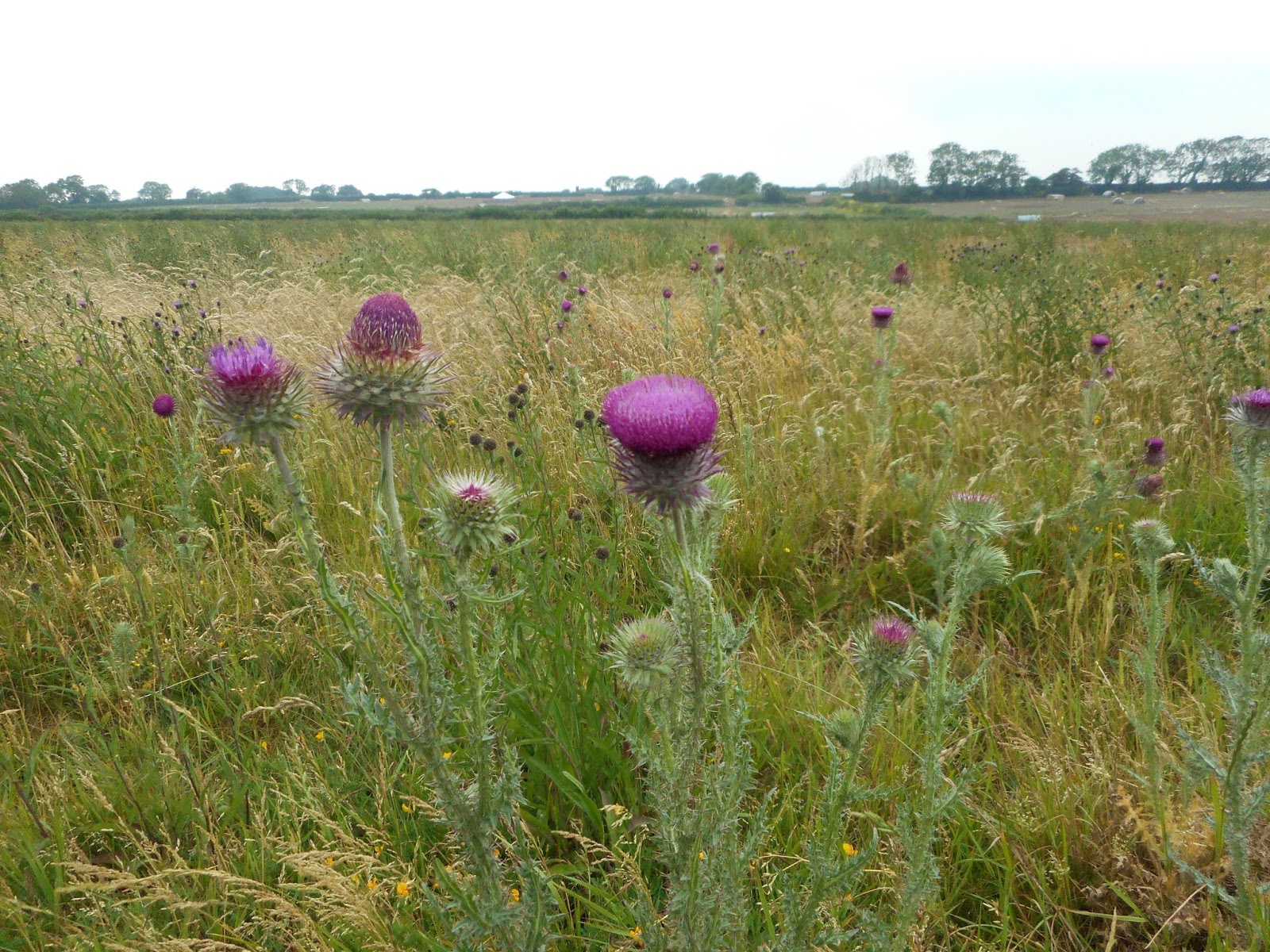
In spite of the weather – or perhaps because of it – there were wildflowers everywhere but I didn’t try and spot them with my usual enthusiasm. I was too busy trying to keep the wind and rain out of my eyes. Nor did I want to photograph them and get my camera wet. Until, that is, we saw these magnificent thistles*. For some reason I thought of the Queen’s crown and its gaudy jewels.

Crown jewels?


A brave bee, feasting on a thistle in spite of the weather


Out in the open again: the greyness in the background is a mixture of sea and sky

Back along the lane the rain became torrential and Ellie kept looking up at us as if to say, ‘Are you sure we should be out in this?’ A couple of weeks ago, with the weather scorching and Ellie finding it almost too hot to walk, we’d taken her to the dog-groomer and had all her thick fur cut off. Now, when I patted her new short dense coat, she squelched like a sponge. Frog’s trousers were sticking to his legs and I could feel drips working their way down the inside of my clothes.

Ellie a week or so ago with her new haircut. I think it makes her look sweeter and more vulnerable. Frog thinks it shows up her true unscrupulous nature.

In the hamlet again, we passed this ruin which always intrigues me. With its elegant pillars, it looks like the gatehouse to a stately home, so what’s it doing surrounded by farms? And anyway we don’t do ruins in the UK, except deliberately (usually churches and abbeys). Everything is turned into something. We need the space.


The forgotten building we saw on our walk, next to a cottage and a barn but with classical lines and elegant columns

A ruined church on Burrow Mump, a conical hill in the middle of the Somerset Levels

Unlike the Greek island we visit where abandoned buildings can be seen all over the place, especially inland. I’m not an expert but I think this is because tourism has taken over from farming in the islands and tourist accommodation is usually on the coast.  Also, it’s probably cheaper to build from scratch than turn an ancient building into something with modern facilities like air-con and wi-fi. Perhaps it’s also a sign of depopulation - people moving to the cities or abroad in order to make a living. Sad.


Greek island houses, in ruins

A ruined Greek windmill

Back in the car, however, we thanked heaven for civilisation and steamed gently all the way home.

Wildflowers seen
(or at least the ones I noticed, through the wind and rain - there were probably many others)

Bacon and eggs (Birdsfoot-trefoil)
Blackberry
Buttercup
Cat’s ear
Cow parsley
Dog rose
Elder
Foxglove
Hedge bedstraw
Herb Robert
Honeysuckle
Knapweed
Ox-eye daisy
Red campion
Scentless mayweed
Thistle*
Sweetbriar
Wild carrot
Wood sage
Yarrow


*When later checking something in one of my books (Richard Mabey’s Flora Britannica) I came across a picture of the Musk Thistle and recognised that it was the one I saw on this walk. It has a slightly musky smell apparently and grows on chalky soil, which most of Devon doesn’t have, but this area does - which means I don't normally see it which explains why it jumped out at me.