Tuesday, 18 August 2020

Hoist with my own petard

It’s all my fault, I thought, as I surveyed the remains of my purple sprouting broccoli, my fault for saying (in ‘Living together’) that we should welcome nature into our houses and gardens.


It was my second attempt at growing broccoli. The first lot I’d grown from seed and then potted up too soon. The little plants had never recovered, so I next bought a tray of seedlings from the garden centre. I left them uncovered for twenty-four hours before potting them up, thinking that they were too small to be of interest to the cabbage white butterfly. I was wrong. Even though I’d subsequently netted the pots (after I potted up the seedlings), the butterflies had obviously got there first, and now a host of caterpillars was munching its way through the crop.


On the soil around each stalk were strange jewel-like deposits. Were these the eggs of yet more caterpillars?


Either the plants would recover, or they wouldn’t, I thought. I might as well now practise what I’d preached, un-net the pots and let the birds enjoy the wee small beasties.

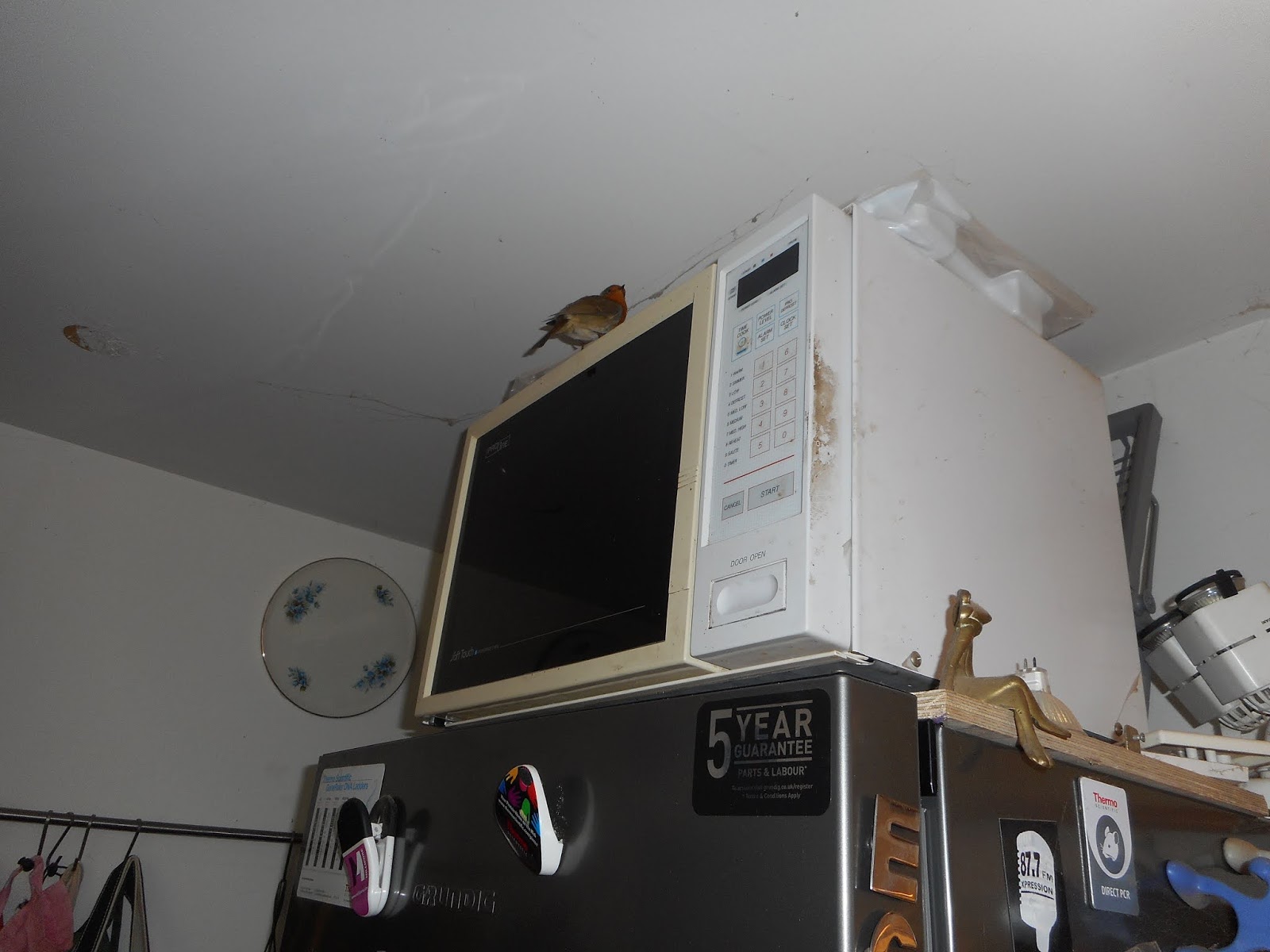
Then birds started invading the house. First, according to Frog, a wren had appeared while I was out walking the dog. It wasn’t there when I got home so it must have escaped through a window. Instead a robin now entered the kitchen and, after flying around banging itself against walls, perched on top of the microwave, which lives on top of the fridge as there’s nowhere else for it. It’s lucky both Frog and I are tall.


Usually, we reckon that birds arrive to tell us when they’ve run out of food, but all the feeders were full and this bird just sat there looking stunned. We wondered if it was a young one that didn’t quite know what it was doing.

Frog, who’s good with errant birds (and errant bees), stood on a stool and enticed it on to his finger.


We then took it out to the caterpillar-infested pots, thinking that we could ‘kill two birds with one stone’ – reduce the population of caterpillars and feed this poor lost creature. Frog even put some of the beasties on to his hand and put his hand under the bird’s beak.


The robin ignored them. It didn’t move. It just sat there looking miserable.


So we left it alone and when I went back half an hour later it was gone. The caterpillars were still there unfortunately and had started falling off the pots and drowning in the water left in the tray by torrential rain.

In my last act of nature conservation, I took the pots out of the tray, tipped the water out and returned the pots to the tray. That way, I thought, both the caterpillars and the plants might stand a chance.

Saturday, 15 August 2020

Blue

Recently, three plants with flowers the same shade of pale blue-mauve have come to my attention, and I thought I’d share them with you.

I know I bang on about wildflowers, but someone has to. They almost never feature on television wildlife programmes but they’re just as important as fauna. None of us would be here without them, and each variety has its niche.

Chicory

Frog, Dog and I saw this uncommon plant yesterday while taking one of our regular routes along the East Devon coast. I also see it from time to time in the organic vineyard behind our house. According to the books it occurs on chalky soil (which that at home definitely isn’t) – but what do the books know?


Chicory, along the East Devon coast, yesterday

Chicory, a few years ago in the field behind the house (used for both growing vines and storing cars . . . ). It's a tall plant


Chicory belongs to the Dandelion family and has the same square-ended petals as Cat's ear (mentioned in a previous post)

Chicory's ground root used to be added to coffee to make it go further, and I remember my mother using ‘Camp coffee’, a sweetened liquid mixture of coffee and chicory, in her scrumptious coffee cake. Apparently chicory is now used on its own as a drink because it’s caffeine free (but what’s the point of that?).


Phacelia

While out and about on the edge of the Somerset Levels last month with Frog and Dog, I saw this plant on the edge of a field. It gave me a shock as I’d never seen it before, or anything like it, and it didn’t appear to belong to any plant family that I knew about. It was like seeing a Martian.


Back home I emailed Plantlife, the wildflower charity to which I belong, and they emailed back the following:

The plant is Phacelia Phacelia tanacetifolia, an annual which is native to the western US. It is widely planted on farmland as both a cover crop or green manure, or as a nectar plant for insects. Once planted, it does sometimes persist for a few years, and it can just pop up from spilled seed or bird feed, or as a contaminant amongst other sown seed.

I was impressed with the answer (its detail and its speed) and encouraged to learn that I was right to see the plant as an alien. I had heard of Phacelia, and had even kept a packet in the cupboard for years waiting to use it as a green manure (but had never done so).

Flax

I do see this plant myself, but this year it was a local friend who brought it to my attention, emailing me a few weeks ago to ask what it was. (Very flattering!)

Photograph by Trish Currie

It’s a cultivated plant which sometimes ‘escapes’, used for linen and oil. Flax (flaxseed) oil is the stuff we eat, and linseed oil goes into paints, the floor-covering lino (linoleum) and cattle feed. I seem to remember that we also used linseed oil on our wooden rounders bats at school. It smelt like cucumber.

And here's a picture of a nearby flax field a few days ago.


Photograph by Trish Currie

There is a wild variety of Flax, with smaller flowers, called Pale Flax. It’s a rare plant, of chalky soils again, and I don’t think I’ve ever seen it.

Monday, 10 August 2020

Living together

A couple of months ago, during the lockdown, I caught an episode of BBC television’s Springwatch. Chris Packham was showing the marks on his shed where wasps had been scratching off the wood in order to use it to build a nest. How observant he was, I thought, and how knowledgeable, and aren’t wasps extraordinary, and how extraordinary that I’d never known that this was what wasps did.

For the last four weeks or so, Frog has been building some solar panels for heating the water in our (small) swimming-pool, and last week he sat on the steps next to the shed, plumbing them in.


The shed, the pool and the solar panels, with plumbing in progress
‘Hey,’ he called to me. ‘Wasps are eating our shed. I can see the marks where they’ve been and I can see them doing it.’
    I hurried over, with my camera.
    Synchronicity had struck again. Not only did I now understand what was going on, but I had a chance to see for myself what Chris had been talking about.

Wasp at work


What the wasp left behind


Striped shed, after the wasps have been
‘We ought to follow them,’ I said, ‘and see if we can find their nest.’
    ‘Yes,’ said Frog.
    But neither of us made a move. Even though the wasps seemed good-natured and hadn’t minded me photographing them, there were a lot of them. It didn’t strike us as terribly sensible to get any closer.
    I was surprised however that Frog had agreed with me. He'd come a long way from the person who used to advocate ‘chemical death’ whenever nature invaded.

Later I visited a neighbour to drop off some runner beans. She lets me have her horse manure for my veg garden and I try and reciprocate with some of its produce. She had a garden full of grandchildren but took the time to show me the wild bees who’d made a nest in a wall of her house. The house used to be a barn and the bees had chosen an old beam full of holes. The little black shapes buzzed in and out, ignoring us.
    ‘What a compliment,’ I exclaimed. ‘They must love your garden.’
    ‘Yes,’ she beamed. ‘They’re no trouble and we just use a different part of the garden.’

The wild-bee nest in an old beam
I remembered a bees’ nest that Frog and I had seen hanging like a wind-sock in the doorway of a Greek house during a holiday many years ago (so long ago that I’ve lost the picture unfortunately) and the swallows that nested above the shop doorways and flew around the village's mini-market, perching on top of the fridges.

Greek swallows above a shop doorway

And why shouldn’t they? And why shouldn’t we leave space for bees? And why shouldn’t wasps have a bit of our shed? We can spare it.


Wednesday, 22 July 2020

The Trap, The Sewing Bee and The Novel

It’s been a long time since I blogged – for various reasons – and the longer I leave it the more difficult it becomes to start again. I have however been thinking about a brief update of some of the topics I’ve touched on in past posts, so here it is.

The Trap

The police visited the farmer and he said he wasn’t trying to catch buzzards (which is illegal) and checked the trap every day and let them out. What he was trying to catch was foxes so that he could shoot them as they were killing his chickens.
Apparently it’s legal to shoot foxes – which I didn’t know – so the police left it at that.
I shall still check the trap if I can as trapped birds beat their wings against the bars of cages and can hurt themselves.
And I’m looking into organisations that protect foxes, as I find it horrifying that they can legally be shot.

Earlier post – ‘Meltdown’

Our local fox, last seen in March. Is she still alive? (Photograph by Trish Currie)

The Sewing Bee

My 'tunic of many colours' is at last finished. It’s turned into a dress and changed its name to ‘my lockdown dress’. It doesn't look half bad on, even though I say so myself, and I might even wear it.


My lockdown dress

The Novel

I’ve received the second report and, while it’s more positive than the first one, still flags up lots of problems with The Banker’s Niece (see right). Consequently I’ve decided to leave that novel for the moment and try to start something new. I think I’ve had enough of TBN anyway and the report – though painful – has helped me make a decision about it.
I realise now however that writing TBN has kept me going for the last ten years and that without it I feel like I’m nothing. Hence the lack of blog posts, perhaps.
Fingers crossed that I can start something new.
It was a wonderful experience serialising the novel on this blog (as I wrote its final draft) and enormous thanks to all of you who followed it at the time as well as those of you who've read it since. You've made it worthwhile.


Friday, 3 July 2020

Living and learning on the Jurassic Coast

Wednesday 1 July


Stantyway Farm on the East Devon coast is not just organic: it’s managed for wildlife. This was obvious as soon as we crossed the field that led to the coast path and passed through a swathe of wildflowers.


Lesser Knapweed (related to thistles and daisies) and a small butterfly. (I think it's a skipper.)
Among the wildflowers was Hedge Bedstraw, another of the plants seen on our Wet Walk and which I was waiting to see again so that I could take a picture for Trish. Usually it climbs hedges (unsurprisingly) but here it was sprawling on the ground.


Hedge Bedstraw
It smelt delicious, which I hadn't noticed the plant doing before, so must have been at its flowering peak. It's not the smell of the flowers however that give the plant its name. It's the smell of the dried plant as a whole, said to be long lasting and like new-mown hay. Because of this people used to pile it under their sheets as a fragrant mattress.

I also saw its yellow cousin, Lady’s Bedstraw, equally fragrant but not such a climber as the white variety.


Lady's Bedstraw
Women used this Bedstraw in particular as a mattress because it was said to help with labour. Interestingly, however, one of my reference books says that the Hedge version is now used for a drug to stimulate the uterus.

You don’t usually see Lady’s Bedstraw in Devon because the soil is wrong, but along the East Devon coast the rock starts to change from sandstone to chalk, and chalk-loving plants – such as Lady’s Bedstraw - mingle with the usual Devon ones.


Along the East Devon coast the rock changes from sandstone (the red in the distance) to chalk (the white in the foreground)
(Nearly a hundred miles of coast in East Devon and Dorset are called the Jurassic Coast and designated a World Heritage Site because the rock layers have tipped sideways making it possible to read the Earth's geological history in sequence. The chalk layer/stretch is famous for its fossils.)


Then, along the coast path, I saw this plant I’ve never ever seen before anywhere. I knew from its shape that it was an allium (of the onion family) and when I got home was able to identify it as Crow Garlic.

Crow Garlic
Both my beloved battered Oxford Book of Wild Flowers, given to me by my parents in 1964 for my eleventh birthday, and a 2008 wildflower book, list the plant as common, so perhaps it’s simply that I’ve never noticed it before. As Frog and I keep saying, there’s always something new to notice and learn about when you go for a walk, even if it’s a route you’ve done many times before.

My beloved 56-year-old wildflower book
Now, as well as swathes of wildflowers, there was a band of scrub, and it was here a couple of weeks earlier I’d seen my first Stonechat, which I identified back at home both from my bad picture – taken in a hurry at a distance as the bird flitted between vantage points – and because it was making such a noise and ‘chat’ seemed the perfect name. (In case you can't see the picture clearly enough, the bird is about the size and shape of a Robin, with a red breast and a partial white collar.)

My first Stonechat
I confirmed my identification with a birding friend by email. He used to work as a photographer and said, rather scathingly, ‘It’s a pity your photo is against the light as it’s a colourful bird.’ Yes, I thought, but the sea was in the way.

Today, I saw the Stonechat again, chatting to a similarly shaped but less colourful version of itself, which I presumed (and confirmed later) was the female of the species.

Female Stonechat

In the same area the year before I’d seen my first Dartford Warbler, a rare (and noisy) bird which I identified with the help of the same friend. ‘I’ve never seen one myself,’ he said wistfully. I've not seen another one since.

The Dartford Warbler is rare because it inhabits a particular sort of scrub, and scrub of any sort is in short supply. Long undervalued, scrub is however the habitat richest in wildlife. (For more on this read the fabulous Wilding by Isabella Tree.)

eritage Site, caH
Up on the cliffs, the sky was enormous and the clouds seemed to be exploding towards me. I had a moment of joy.


We left the sea behind and crossed inland to a shady lane, once open to motor traffic but now reserved for walkers and cyclists. A gorgeous smell erupted and even Frog – who doesn’t have the best of noses – noticed it. We followed the smell like Springer Spaniels and collided with this flowering tree.


Lime,’ said Frog. Sublime.

Down the lane, clinging to the hedge, was another surprise, another plant I didn't remember ever seeing before. Back home I identified it as Wild Madder.

Wild Madder
I must have seen it before however as I’d pencilled ‘especially by the sea’ in my Oxford book (information which on checking I found came from my serious botanical book that I only consult as backup because it uses so many abbreviations that its information is hard to decipher). I’d probably therefore seen it in the same place. Tut, tut. Why hadn't I remembered?

My serious botanical book says the plant, which grows only in Wales and the south and south-west of England, is frequent or 'locally abundant' (which means it's only found in certain places but where it is found there's lots of it). Neither frequency or abundance is my experience, so either the book is wrong, or the plant has become less common in the last 40 years, or I've not noticed it, or I've been looking in the wrong places.

Wild Madder is related to the plant which produces the red dye ‘madder’, as well as to our old friends the Bedstraws, seen at the beginning of the walk.


Books

The Oxford Book of Wild Flowers (Oxford University Press, 1960)
(Out of print now but available – at a cost - secondhand)

The Wild Flower Key by Francis Rose (Frederick Warne, 1981)
(The serious botanical book)

Flora Britannica by Richard Mabey (Sinclair-Stevenson, 1996)
(An enormous chatty tome, covering all aspects of wild plants – folklore, history, uses, variations of common names)

The Wildflowers of Britain and Ireland by Charles Coates (Frances Lincoln, 2008)
(Good on folklore and herbal uses)


Wilding by Isabella Tree (Picador (paperback), 2018) (A rewilding classic, telling the thrilling story of how the author and her husband turned Knepp, their 3,500-acre estate in southern England, back to nature)