Wednesday, 28 March 2018

Images


Because I haven't got time to write, because I'm trying to work on The Novel instead of blogging, here are some images from the last few days.


Last week: a snowdrift with razor-sharp edges almost blocks the path. (Spot the dog.)

On the coast at the weekend. A tree decorated with ribbons and . . .
. . . in the hedge below, a photograph. Are they connected? What do they mean?
'My' island on Monday. A nearby tree has been uprooted and deposited on top of it. The river is still just too deep for me to wade across.


Sunday, 18 March 2018

The world is beautiful now


I might already have three items for the list mentioned yesterday.

1 Expect the unexpected
We don’t know how things are going to turn out. They might even turn out well, in spite of all our fears. For instance, I never expected to wake up this morning and find the world transformed into a fairy tale. (I ignore weather forecasts and media warnings on principle, especially after the frenzy a few weeks ago.)

2 We are not in charge
In common with AutumnCottage Diarist, I appreciate the loss of control that extreme weather brings. Extreme weather reminds us that we are part of something bigger. We are not unimportant, but nor are we in charge. That is hugely reassuring.

3 The world is beautiful now . . .
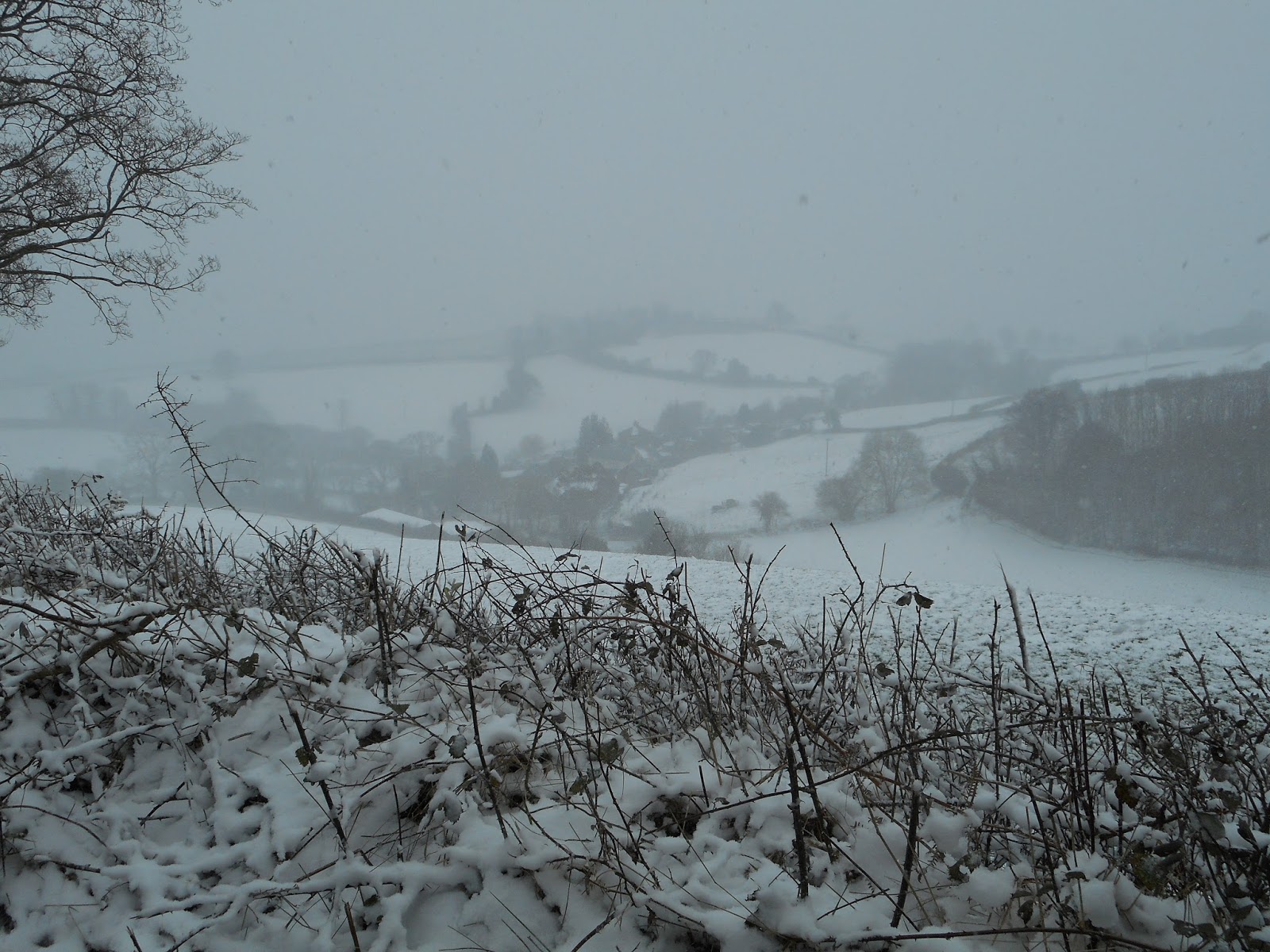
. . . whatever happens in the future. And here are some pictures taken this morning to prove it (I hope).

Whiteout
Trying to photograph snowflakes falling . . .
What is sky and what is earth?
For once Ellie is camouflaged (albeit muddy)
Snow building up along the bottom of my workroom window as I write
And now I really must stop blogging and get back to The Novel.

Saturday, 17 March 2018

Grief, death and positivity


In spite of everything I’ve been saying, I think I am struggling with grief at the moment. And part of grief I suppose is the way it brings death to your attention. In my case, that’s not just the death of my mother, but the future deaths of Ellie the dog, Frog and me.
Who will go first and how will I cope? How will I cope if Frog goes first and I’m left here on earth on my own? How will I cope if I go first and have to travel through the realms of death (whatever they are) without Frog to hold my hand?

And it’s not only those three deaths. What about the current rapid decline and possible future death of the natural world, which is a constant grief for me, exacerbated both by bereavement and by three books I’ve been reading.

In the novel Brendon Chase, probably set around the time of the First World War when the author was a boy, three boys run away from home and live wild in the forest for nine months.
The Peregrine details sightings of this bird and other wildlife around an Essex estuary in the 1950s and ’60s.
Common Ground, published in 2015 (and which I haven’t yet finished reading), describes the author’s intense relationship with a patch of forgotten countryside on the edge of the town where he lives.

Although I didn’t plan it that way, reading these three books – in date order – shows up the decline in the natural world with excruciating clarity.
In the novel, the boys hunt, shoot and trap wild animals without a qualm: they joke for example that they can’t eat duck any more because they’ve killed all the birds which used to live on the pool nearby. Could you even live in a forest any more for that long without seeing anyone else (except in their case a charcoal-burner)? Do forests that size still exist and would they be people-free?
At the time of the writing of The Peregrine the bird was threatened with extinction and the author writes of the landscape, ‘It is a dying world, like Mars, but glowing still.’ That still holds true, even though peregrine numbers are recovering with the banning of certain chemicals, and he describes a host of other wildlife which I never see or hear any more (partridges, cuckoos, thrushes).
Common Ground brings us up to date. The countryside described is anything but pristine. It contains litter, discarded barbed-wire (which kills a fox), a derelict railway, electricity pylons, traffic noise and a rough sleeper. Even so, the author loves it (because of the way it is, not in spite of). He discovers that it is earmarked for development – 900 houses. But what can he do?

What can any of us do? How can we stay close to nature when nature is vanishing? How can we live in a way that is not destructive to nature? How can we help stop the decline? And am I even asking the right questions?

I think I feel another list coming on. A list of answers, I hope, as well as a list of ways to stay positive, of antidotes to grief and death.

But that could take some time and now I must walk the dog.


Wednesday, 14 March 2018

Small and independent publishers


Although I don’t take the magazine, I’m on the emailing list of Mslexia (‘The magazine for women who write’) and a couple of weeks ago I received a message from them about a new edition of their guide to small and independent book publishers (available from both Mslexia and Amazon). It was just the spur I needed to pick up my novel again.

I had to abandon the novel four years ago when I took over as editor of a local magazine but I resigned that post this time last year, about the same time as my mother died. Having taken a year off from everything and with the passing of the anniversary of my mother’s death, I began to think it was time to stretch my creative wings. The email arrived at just the right time, as things always do.

I can cope with a small independent publisher, I thought. Neither I nor my writing is ready for big international publishers and pushy agents. I’ll just zip through the novel and sharpen it up and then send it off.

That, of course, has not turned out to be the case. As I get into the novel I find that it needs more than a sharpen and is going to take me at least a month or two to pull into shape. It isn’t half fun though!


Because I’m not very clever I may not be able to work on this blog at the same time as working on the novel. The blog has however been a lifeline over the last year and I shall do my best to keep it up. Thank you for being there.


Tuesday, 27 February 2018

Anniversary list


Yesterday was the first anniversary of my mother’s death and I was all set to write a list of everything I liked about her.
    Frog and I had been spending all our spare time over the last two or three weeks pruning, hedging and clearing brambles in an effort to retrieve our views. Being outside so much had helped my mood and I decided that the time had come to be positive about my parents.

A trimmed (wild) hedge and the return of our westerly view
Pruned shrubs, cleared brambles and the return of our southerly view
Then at 3am I woke with a migraine. I dragged myself through the day, beating myself up for my backsliding, and the list didn’t get written.

Today, feeling a bit better, I went into Exeter to do some errands and got talking to my favourite Big Issue seller. His gorgeous greyhound George wasn’t there and, knowing how poorly George had been, I feared the worst. As he told me about George’s last days and how he’d buried him and how his mother had put a twig on the grave, and I talked about the death of our previous dog Penny, we both started crying.
    ‘I didn’t mean to cry,’ he said, ‘but you can always tell a dog-owner. They have an extra spark of humanity.’
    I bought him a coffee and walked away, somehow connecting what he’d said with my migraines. I'd always thought they were a sign of my lack of humanity, of being emotionally stunted, but maybe they were the opposite. Confused and angry I might be at the moment and often unable to see the way forward, but at least I am reacting to life.

So, thank you George, and thank you Big Issue seller, whose name I don’t know, and here is the list.


Things I liked about my mother

  • She let me watch and help her cook.
  • She taught me to sew.
  • She instilled in me a love of reading, by reading out loud to me and my brother when we were young and then going backwards and forwards to the library fetching us books.
  • She showed me by example and encouragement the importance of good food, fresh air and exercise.
  • She and I used to giggle helplessly together at the same inappropriate moments (eg in church or when eccentric relatives visited).
  • She was glamorous.
  • She had a tendency to dissolve into tears.
  • She was open about parts of the body and bodily functions.
  • Whenever she used a rude word (‘Hell’s bells’, ‘Like shit out of a goose’) she blamed her brothers.
  • She loved giving presents.(And here are two of them, which I'm using every day in the cold weather at the moment.)
Two soft warm scarves given to me by my mother - a pinky-red pashmina and a faux fur