Saturday, 19 February 2022

Frog

Frog died suddenly of a heart attack at the age of 69 on 5 January this year. Today would have been his seventieth birthday.

When I first met him 44 years ago I knew that we’d been together in previous lives. All I can hope for now is that we will meet again and be together in a life or lives to come.

We had his cremation last week and Mark Gilborson, the Civil Celebrant, found this poem for me and read it out at the service. It is one of my lifebelts.


Death is nothing at all

 
Death is nothing at all.
I have only slipped away to the next room.
I am I and you are you.
Whatever we were to each other,
That, we are still.
 
Call me by my old familiar name.
Speak to me in the easy way
which you have always used.
Put no difference in your tone.
Wear no forced air of solemnity or sorrow.
 
Laugh as we always laughed
at the little jokes we enjoyed together.
Let my name be ever the household word
that it always was.
Let it be spoken without effect.
Without a trace of a shadow in it.
 
Life means all that it ever meant.
It is the same as it ever was;
There is unbroken continuity.
Why should I be out of mind
Because I am out of sight?
 
I am waiting for you, for an interval,
Somewhere very near, just around the corner.
 
All is well.
 
                    Henry Scott-Holland (1847-1918)


Frog at one of his favourites jobs:
clearing the drains in the road below the house so that it didn't flood


Frog in his den (a semi-underground music room)

Friday, 18 February 2022

Rewilding update

The tree people arrived in the middle of January: lovely Irish Ken Hogan (www.kenhogantreeservices.co.uk ) bringing with him a cake for me from his lovely wife ‘Mole’ together with an assortment of young lads.

They chainsawed the dreaded Leylandii which were blocking all the light at the bottom of our garden. They were able to leave stumps some four foot high as conifers don’t resprout like broadleaved trees do. These stumps will become covered in ivy, which provides food and cover for birds and insects in the winter.

A Leylandii stump (and my neighbour's house)

With a powered winch, they hauled out the remains of the field maples which had been taking up more and more space and obscuring our lovely views. They left these rooted stumps upside-down in piles as habitat for creatures of all shapes and sizes. These piles I discovered are called, unsurprisingly, ‘stumperies’.


Stumperies

They sliced the tops off the willows and elder that had grown unbelievably tall and spindly in order to compensate for the Leylandii. Although all looks bare now, these should bush out and give us much better screening than before while restoring our sight of the horizon and sunsets.

A once-leggy tree, ready to bush out

I called this ‘coppicing’ but Ken called it ‘pollarding’. Google says that ‘coppicing’ involves cutting trees back down to ground level, while pollarding means leaving them a few feet high, so Ken is right.

With a mammoth machine they shredded most of the piles of cuttings that Frog and I had made in the autumn when we started trimming everything, as well as all but the largest of what they had produced. This they chopped into logs for my neighbour who has a wood-burning stove (and has been supremely tolerant of all the work and told me to do what I liked).

They left some piles of wood around . . . 

A pile of wood (to the right) and my shadow

. . . as these host insects and fungi and rot down to nourish the soil, as well as making good hiding places for small mammals.

They also placed some of the cuttings in a line as a sort of hedge.

The row of cuttings. (The fence is there to stop Ellie racing into the road or into my neighbour's garden.)

This provides a structure for things to grow through and can be added to as cuttings become available. Again, it provides habitat for fauna and, I discovered, is called a ‘wind-row’, so I suppose it gives protection against wind (of which we get a lot).

They left the shreddings in a massive pile next to the house. Neighbours have been helping themselves to carloads of the stuff for use on muddy paths and I’ve been putting them in the deep holes left when the field-maple roots were pulled out as well as on my veg beds as feed and mulch. As you can see, however, there’s still quite a lot left.

A root-hole filled with shreddings

Shreddings mulching one of my veg beds

A beached whale of shreddings. As you can tell, this pile was once double in size and stretched out on to the grass. Thanks to my sister Anna who spent a long time scraping the chippings off the grass when she came to stay.


We’ve now discovered a whole new section of garden and have the makings of what I see as a ‘dappled dell’.


The dappled dell

Already snowdrops and other bulbs that I never knew existed are pushing their way through.

Snowdrops which have appeared by magic in a part of the garden once dark and dead.

In due course, I might plant one or two small trees with blossom and food for birds, such as crab-apple or hawthorn, but I’m not in any hurry. I shall see what happens naturally first.

Meanwhile, I’ve had to completely rearrange the sitting-room so that we can sit on the sofa and take in the glorious views. And when the weather’s better I might even manage to take a picture of what we can see.

Once, we cowered in the middle of a wood. Now, we live on a mountain-top.


Thanks once again to my lovely nieces and nephews who’ve shown such interest in my rewilding project, not least Mark who's just started a business https://www.aklimate.co.uk/   helping organisations to be carbon neutral. 


Saturday, 18 December 2021

Rewilding the garden

As Exeter expands ever closer, as my walks are increasingly restricted by barbed wire, impenetrable fences and ‘Private’ signs, and as fields and hedges are tidied and tamed, I’ve decided to create my own patch of wild nature by doing everything I can, with Frog’s help, to encourage it into our garden. Here’s how we’re doing it.

During the summer, except for the bit near the house where we sit, we let the lawn grow. Ox-eye daisies and Meadow cranesbill, that once upon a time I planted in the flower-beds, escaped to bloom in profusion, and all the low plants like self-heal, that usually never got much of a chance, spread beneath them in a carpet of colour and bees. It all looked and sounded gorgeous and lifted my heart every day. (Unfortunately I wasn’t taking photographs at the time so can’t share it with you.) I was astonished how much could happen in such a short time

In September (I think), after the flowers had set seed, we cut and raked the area. (It’s important not to leave the cuttings as they fertilise the soil, and wildflowers do best on poor soil.)

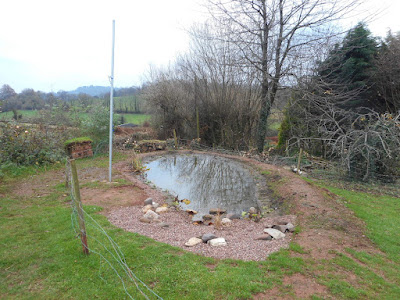
In October, with professional help, we dug a pond and semi-planted it with appropriate wild flowers. I didn’t want to cram it with plants as I’m keen to see what arrives of its own accord. Apart from anything else, these plants are what will do best. Also, I need to see how much of the bank stays damp in the summer – ie how much the liner intrudes. 
Photograph copyright © Belinda Whitworth 2021
The new pond
(The fence is there to stop us and The Dog churning up the mud.)

Already, birds are using the pond for paddling and drinking. A few weeks ago it froze over, but the middle is very deep (3-4 foot?) so creatures like dragonfly larvae will be able to survive.

The plants are in sacks of soil around the edge, not plastic pots.

Photograph copyright © Belinda Whitworth 2021
The sacks of soil around the edge of the pond, with some planting

There is a good shallow area, as this is where the water is warmest and tadpoles thrive, and an extensive beach so that amphibians and other creatures can get out.

Photograph copyright © Belinda Whitworth 2021
The pond's shallow margin and beach


To one side of the pond with some second-hand bricks we'd acquired, the pond people created a bug hotel. I’m not sure about it as our banks are full of holes anyway, with bees going in and out of them, and I prefer to keep things as natural as possible. Maybe its position next to the pond is the important factor. I shall monitor it.

Photograph copyright © Belinda Whitworth 2021
The bug hotel

They also created this formal log-pile next to the pond as shelter for amphibians and small mammals, which again I’m not sure of as we already have plenty of untidy piles of logs. We shall see.

Photograph copyright © Belinda Whitworth 2021
The tidy log-pile

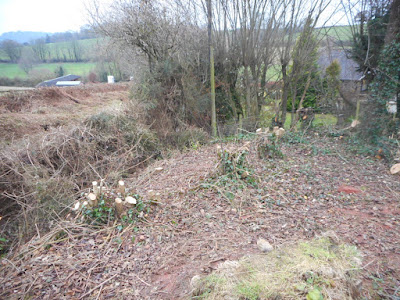
With the pond, we viewed our garden in a whole new way. We saw how dense the trees at the bottom of the garden had become, how much they obscured our lovely views and how much shade they cast, particularly over the pond. We did a lot of clearing.
Photograph copyright © Belinda Whitworth 2021
A cleared area

The stumps you can see in the picture above will be dug out. They are mostly Field maple which grows fast and big and can't be laid as it's too brittle. It was a bit of a nuisance actually.

We finally got round after 41 years to arranging for these Leylandii to be removed (in January before the nesting season) as they’re not native and everything around them was dark and dead.

Photograph copyright © Belinda Whitworth 2021
The Leylandii (in the background)

As firs don’t re-sprout like broadleaved trees do, we’ll be able to leave a good stump. This should be colonised by ivy, valuable cover for wildlife and a source of nectar and berries in autumn and winter when there’s not much else around.

At the same time these Willow (I think) trees, grown tall and spindly in their efforts to reach the light, will be coppiced so that they bush out. That way they’ll provide thicker, safer places for birds to nest and roost, be a better screen between us and our neighbours, and return to us our view of the horizon.

Photograph copyright © Belinda Whitworth 2021
Trees for coppicing

I envisage the area as a small dappled wood as it already has Holly, Elder, Blackthorn and Wild cherry. I’ll see how these trees change with the increased light and space and if necessary, after I’ve watched the spot for a year or so, I may plant one or two more trees. We had an enormous flock of fieldfares (refugees from the cold further north) scoping our garden for a week in November and I felt awful that we didn’t have any food for them as the few berries we do have were all gone. A hawthorn or a crab-apple might help.

Fired with enthusiasm and while the digger was on site, we cleared the shrub bed next to our terrace. Not only were the shrubs non-native, but they stopped us seeing our new wildflower meadow. We seeded it with a (native) wildflower-meadow mix which included a plant called Yellow rattle. This steals nutrition from grass, thus deterring the grass and allowing wildflowers to thrive, and is a vital ingredient of wildflower meadows. I’m hoping the Yellow rattle will spread to the bits that were once lawn.

Photograph copyright © Belinda Whitworth 2021
The ex-shrubbery, soon to be a wildflower meadow.
(The pole is one of three that hold up our shade-sail in the summer.)

We also sowed wildflower-meadow seed on all the muddy patches around the pond and on the bald patches that had arisen in the rest of the garden because of the traffic to and fro.

Scrub (shrubs) is an important wildlife habitat so we’ve left our other shrubbery, even though it’s non-native and a bit of a disaster by conventional standards (overgrown with brambles and nettles, part dead, mis-shapen etc etc). I’ll work out what to do with it in due course.


Photograph copyright © Belinda Whitworth 2021
The overgrown shrubbery (with cuttings in the foreground)

Because of all our efforts we now have piles of cuttings and logs all over the garden.


Photograph copyright © Belinda Whitworth 2021
A cuttings pile, one of several around the garden 

We won't burn the cuttings and add to the world's greenhouse gases. Instead, some of them will be shredded by the tree surgeon, and the shreddings/wood chips then spread on my veg beds where they quickly break down and nourish the soil, or used to firm up muddy paths (of which we have many).

Incidentally, a couple of years ago I had a pile of shreddings which I covered with a tarpaulin so that they didn't rot too much before I got a chance to use them. When I came to lift the tarpaulin a few months later there was at least one grass snake and one toad living there - which just proves that, given the habitat, wildlife will arrive, and the more untidy you leave your garden the better.

The rest of the cuttings we plan to leave unshredded and lay inside one of our boundary hedges as extra cover for wildlife.

Photograph copyright © Belinda Whitworth 2021
This hedge has a double layer of trees, with a gap down the middle which
The Dog loves running along. We plan to spoil her fun by filling the gap with cuttings.

Frog and I are in the process of laying this hedge in order to both thicken it and retrieve some more view. Frog is good at wielding a chainsaw and has some training in the Devon laying technique and I’m a keen dragger and piler of bits as I love being outside and having a simple physical task. Whether we manage to complete that job this winter is debatable and in any case it’s probably best not to upset the wildlife too much all at once.

And before I forget to mention it, we’ve also removed as much fencing as we can around the outside of the garden as this might deter larger animals like foxes and badgers. We had to put it up to stop The Dog squeezing through the hedges, racing out into the road and chasing vehicles, but now she’s a sensible (?) eleven and a half years old we hope she’ll content herself with barking instead. (So far so good.)

This is a very long post. I was going to tell you about The Novel as well, but maybe that will have to wait for another day.

And I realise now that none of the pictures here, being mostly of mud, is very inspiring. I’ll try and post some more in the spring and summer as my vision becomes a reality.


This post was inspired by my lovely niece Lucy who showed an interest in what we’re doing in the garden and asked me to send her some pictures. Thank you Lucy!

Sunday, 14 March 2021

Novel-writing and wildflowers

It’s over a month since I posted here and I wanted to explain why. You may not have noticed my absence, but I feel bad leaving without a word.

The reason I've been silent is that I've received a positive report on my novel (hooray!) with lots of helpful advice for improvements which I'm busy putting into effect.

I’ll try and keep you posted with any further progress.

In the meantime here are some photographs of wildflowers which have appeared recently – in spite of the rain, wind, frost, hail and sleet. 

First, Greater Stitchwort which I saw yesterday (Saturday). Unfortunately, it was hailing at the time, so I didn’t dare get my camera out, and these pictures are from my first sighting last year on 7 March (almost a week earlier).
I see a note in my wildflower book which says that in 2005 I saw it on 20 March, a week later than this year. 
I always rejoice to see it as it’s the first of the hedgerow plants to appear.
The flowers are about half an inch across.


Greater Stitchwort, Devon, 7 March


Greater Stitchwort, Devon, 7 March

Greater Stitchwort

Second, Marsh Marigold, which also goes by the lovely name Kingcup. I saw the first ones out the day before yesterday (Friday). It’s a giant fleshy buttercup that grows in boggy places like watermeadows or the edges of ponds. 

This picture is slightly lacklustre as I couldn’t get close, and only a few of the flowers were out as yet. If I get a better one, I’ll put it here instead. En masse they are a glorious sight.

Marsh Marigold, Devon, 12 March

Marsh Marigold (the small yellow blobs in the foreground)


Friday, 5 February 2021

Wildflower watch

It’s about this time that I start spotting wildflowers as they begin to appear and – in an anoraky way – making notes in my diary so that I can compare first-sightings over the years.

Primroses

All wildflowers now appear much earlier than they used to as a result no doubt of global warming. Primroses for instance, which I used to think of as a February flower, now appear before Christmas.

Here are some that I photographed today along the edge of our garden. (I do regret the fence, as it’s not good for wildlife, but it is essential at the moment to stop Ellie squeezing out through the hedge and chasing vehicles, the varmint.)

Primroses


The flower won’t however come into its massed glory for a couple of months, such as these that I photographed in April 2017 along a nearby path.

Primroses

 
I remember as a child going on primrose-picking picnics (try saying that a few times) with a friend and her mother, but I would never pick wildflowers now, not even if there appeared to be lots of them. They need all the help they can get, with habitat loss to my mind a far greater threat than rising temperatures.
 
As I said to Frog as we walked along the canal two days ago and I looked longingly at a scruffy and forgotten field-corner, ‘I just hope I live long enough to see large parts of the country rewilded.’
 
Scruffy and forgotten corners are all we have left of real nature - the rest is a green desert – and I can’t begin to count the number of scruffy and forgotten corners where I used to sit and dream that have since disappeared.
 
Europe is in part to blame because it rewards farmers for the amount of land they cultivate and, although I voted to stay in Europe, I may be changing my mind because the British government has plans to reward farmers for the good they do for the environment instead. God willing, those plans will come to fruition. (They could scrap the HS2 railway as well while they were about it.)

Wild Daffodils

Wild daffodils are a case in point. Back in the 1980s I used to see fields of them but those fields have gone, no doubt ploughed up and ‘improved’. The only ones I see now are these that I planted myself at the entrance to our house, which have been flowering for nearly a week and bringing joy to my heart every time I pass them.

Wild daffodils


They’re not the same as the cultivated daffodils which have ‘escaped’ to live wild, being smaller and paler. They come out earlier too. My wildflower books say March but I made a note in 2005 that they’d come out on 1 February, so even sixteen years ago their season had shifted by a whole month. They are the daffodils that Wordsworth saw and wrote about.
 

Snowdrops

Snowdrops on the other hand have been late this year, perhaps because it’s been a cold winter. I usually see them at Christmas in a small bed outside our back door but my first sighting this year was in the wilds of Mid Devon on 22 January on a freezing and wet day. It was so dark that my camera flashed as I took the picture.

Snowdrops

Snowdrops are probably not native, as they weren’t recorded growing wild in this country until the 1770s, but they certainly look at home now, growing in swathes through woods, and here at the bottom of our garden (photographed a few days ago).


Snowdrops


I seem to remember at one time that when you were buying snowdrop bulbs you had to be sure they came from a reputable source and hadn’t been lifted from the wild, but I can’t find anything about that now so perhaps it was a different plant. (Incidentally, it’s illegal to dig up any wild plant except on your own land or with the landowner’s permission.)
  

(Lesser) Celandine

This for me is the real harbinger of spring. Its flowers are like miniature suns, gleaming out of bedraggled hedgerows. One day they’re not there, and the next they’re everywhere. This year that day was Tuesday (2 February), again a month earlier than The Books say.
 
 
Lesser celandines

 
I love their perfect trowel-shaped leaves.


I may continue with this wildflower watch as spring unfolds. I keep looking for my blog’s raison d’être, or USP (unique selling point) as Frog would say, and wildflowers are as good as anything. After all, as I’ve said before (and will say again), no one else in the media seems to care about them. Do please feel free to contribute your own sightings and experiences. I'd like to know about them.