Sunday, 6 September 2020

Trusting the process

One of the comments in the recent critiques of my novel was about plot. Plots, the Reader said, should be allowed to develop organically so that they didn’t sound contrived. I understood that comment completely and realised that the problem in my case is one of trust. It’s quite something to let your novel write itself. Or anything, in fact. Not just novels. The same could be applied to life.

So, with that in mind, I’ve stopped trying to pull ideas for a new novel out of the ether and concentrated instead on developing (organically) the writing I already do. Namely, this blog.

I love blog-writing. Response is immediate and supportive, I’m in charge of the whole process (no publisher to interfere) and there’s no pressure for me to be anything other than myself. I write what I want, when I want. Writing this blog is helping me discover myself.

There’s one part of me however that doesn’t appear in the blog, except in brief hints, and that’s my deeper more troubled self, the one that appears when I have my migraines. At the end of each migraine however, after I’ve battled with pain, depression and demons, I come out with some new insight, some new understanding of life and my way forward.

This always makes me think of C S Lewis’s The Silver Chair (Book 6 of the Narnia series).


SPOILER ALERT Do not read this paragraph if you haven’t yet read the book and think you might do so. Each night a mysterious black knight is tied to a chair because each night he goes mad. The children are instructed that they should on no account untie him, however heart-rending his pleas. They do of course untie him and it turns out that he has been enchanted and imprisoned by a sorceress (why is it that all C S Lewis’s baddies are female?) and that the night-time prince is the real non-enchanted one.

In other words, the migraine me is the real real one, and perhaps if I let it out into my other life I won’t need to be ill any more.

But how do I do that? Do I write about it? Do I write about it in this blog? Do I start a whole other blog? Do I write it as if for a blog – because I like the format so much – but don’t yet post it?

With that in mind, I started a file called ‘My Secret Blog’ and planned what I wanted to say in the first post.

But before I could write it, I received this email from my sister’s partner P, a writer and editor himself as well as gardener, house-husband and all-round lovely person.

You should write a book about wild flowers. Write about them the way you do in your blog. All the old wives’ tales, folklore, natural healing properties, threats to their survival etc etc.

I sent back a lukewarm reply, thinking there were already far too many nature memoirs around, and he continued:

Walking and wild flowers through the changing seasons - like your blog - make it chatty and personal, with all your musings. You write so well - I love it when your blog is all about you and Frog and the dog and your walks, with your lovely photographs of the flowers too.

Hmm, I thought. Perhaps it would be a way to present some of my opinions to a wider audience, and how many nature memoirs are there by women anyway? I could only think of two:


And he’s the second person to have said that, the other being creative writing teacher Roselle Angwin, who’s kickstarted several of my writing projects.


So now, I have two ideas. And I wasn’t even looking for them.

Wednesday, 2 September 2020

An anniversary day out

Tuesday 1 September

Tomorrow is our 42nd wedding anniversary but today is forecasted to have better weather so we decide to take our celebratory day out today. We head for the coast planning to have what may be our last dip of the year in the sea.

We have lunch at a garden centre on the way, sitting on a spacious terrace in the dappled shade of an olive tree with Ellie at our feet. Unfortunately I've left my camera in the car and I can't be bothered to put my mask on and go back all the way round the one-way system to get it.

The path starts at the back of a village's churchyard, . . .


. . . crosses a small stream via a wooden footbridge . . .


and then climbs through a wood.


We pass a clump of Knapweed in full sun. It’s covered with what I think are moths, judging by the way they fly.


Why so many? Is this their favourite nectar-plant? Is there a colony living nearby? Or is it just that the knapweed is at its best? I know very little about butterflies, and even less about moths.


Soon we glimpse the sea.


We head down to our favourite beach, accessible only on foot or by boat. Unfortunately there’s been a landslip and the path has been diverted and we take several wrong turnings - which, as you may have realised by now is normal on our walks. Luckily, today they’re the result of Frog’s choices so I don’t have to feel guilty.

Ellie starts to look unhappy and I wonder if she’s remembering our last visit with my sister and niece three weeks earlier. Because of the diversion, the final climb down to the beach has to be made on a precarious ladder 20 or so feet long. Then, even though she was shaking, Frog was able to pick her up under his arm and carry her down, but today she struggles frantically and (by mistake) makes bloody gashes all the way up his forearm with her claws.


Somehow though we all make it down. The beach is empty . . .


. . . which is a good thing as Frog has forgotten his swimmers and has to go into the water in his birthday suit.

The water is divine. Calm, clear and surprisingly warm. I put my head under several times, hoping to clear my slight migraine. I wonder if the migraine is the result of the significant date which makes me even more aware than usual of my inadequacies (of which more in another post, perhaps).

We bask in the sun, while Ellie lies in our shade, panting and drinking copious amounts of water. Last time we brought a sunshade for her but then we had an athletic 18-year-old with us who carried it. We decide it’s time to move. 

Ellie is much happier getting back up the ladder, mostly under her own steam with Frog helping.


Now we’re more sure about the path, we have time to savour the walk through the undercliff. I remember that early new potatoes used to be grown on terraces here up until quite recently and I wonder how on earth they managed to clear some space.


As well as wildflowers there are berries everywhere, including these which I think (and later confirm) belong to the Common or Purging Buckthorn.


In spite of its name, it’s apparently much less common than the Alder Buckthorn, which has red or purple berries and I think I may have growing in the garden from time to time but have yet to confirm, and strongly laxative as you might expect. According to Richard Mabey in his Flora Britannica: ‘when the latrine pits of the Benedictine Abbey at St Albans were excavated in the 1920s, great numbers of [Purging] buckthorn seeds were found mixed up with the fragments of cloth the monks used as lavatory paper.’

It grows on chalky soil and, as we’re on the East Devon coast where (as I’ve said before) the soil starts to change from sandy to chalky, that makes sense.

I’m interested in the Buckthorns because at the start of the Lockdown I saw my first Brimstone butterfly, a gorgeous lemon-yellow fluttery thing, and the Buckthorns are where the female lays her eggs. (What was I saying earlier about each type of wild plant having its niche . . . ?)

As we turn inland to walk back down to the village, I take my last look at the seascape - it may not be as stunning as the Mediterranean, but I love the soft blues and greys  . . .


. . . and at the village church . . .


. . . which makes me think of that other church where Frog and I married all that time ago, in that other village where we still live.

Just married

Saturday, 29 August 2020

Exploring Exmoor

Wednesday 26 August

Map extracted from Ordnance Survey Outdoor Leisure map 9 of Exmoor

Our walks were becoming samey so we decided (sorry, I decided. Frog likes samey) to continue with our exploration of Exmoor. We’d been there quite a few times but had yet to find a walk we wanted to repeat. We decided (I decided) that we should head diagonally across the moor on a B road and stop at Winsford Hill, the first high point on the route.

We had an additional reason for our expedition. One of my sisters and her daughter had been to stay a couple of weeks earlier (much joy) and were going home (to Kent) via a stop in North Devon. I directed them on to this very same road, saying that the A road which goes round the moor wasn’t exactly easy (lots of twists and turns which make me queasy) so they might as well take the scenic route. My sister wrote afterwards that Exmoor looked stunning but ‘the 1 in 4 gradients were tests of our driving skills and the car’s brakes’. I felt a bit guilty and wanted to check out my advice, seeing as I couldn't remember when I'd last taken that road, or even if I ever had.

Dulverton

Dulverton on the edge of the moor was thronged with happy people in shorts and sandals. The town sits underneath steep wooded hills and always makes me think of Tolkien’s Rivendell. In winter it’s dark but today it was bathed in sunshine and I almost wished we were stopping for lunch. We’d decided however to take a picnic and not risk discovering that the eateries were still closed or imposing such stringent rules that visiting them was a penance.

Winsford Hill

As we climbed out of the car at Winsford we were hit by a cold wind. Frog had sensibly brought a jumper but I shivered in my t-shirt and waterproof. We know that it’s always colder (and wetter and windier) on the moors but it’s hard to believe that when you’re basking in warmth at home.

The Punchbowl

I’d seen interesting contours on the map and something called The Punchbowl and this was the first thing we encountered. It was impressive. Semi-circular, steep, not to say vertiginous, and matted with dark green trees and bushes. As I took out my camera, Ellie rushed to the edge to look over.

Ellie investigates The Punchbowl

Nervously we called her back.
    ‘It looks like something made by a glacier,’ I said, dredging up memories of geography lessons some 55 years earlier. ‘I think it’s called a “corrie”. But did the ice get this far south in the Ice Ages?’*
    I was intrigued by orange blobs hanging from what looked like dead branches. They were everywhere, hallucinogenic against the lowering clouds.
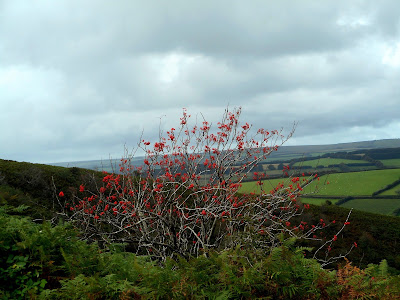
What are these hallucinogenic orange blobs?

I realised that they were of course rowan berries, but where were the trees’ leaves? There were a few other species of tree around and they all had theirs. It was exciting to see the rowans nonetheless as I only ever come across them on the moors and they always feel a bit magical. We had tried to grow one at home but it didn’t survive.

We stopped to eat at a grassy circle under a stunted hawthorn: Frog’s horrible shop-bought orange (red-pepper) hummus and my home-made stuff. For the first time, at the insistence of my sister, I’d boiled by own chickpeas. The hummus was crunchy and didn’t actually taste as nice as the stuff made with shop-cooked peas. I’d obviously undercooked them. (Will I ever make a proper housewife?)

A man in a Barbour walked past with three spaniels. He had the confidence of a local and I was hugely embarrassed when Ellie leapt out at his dogs, barking. Already she’d staked out our picnic area as her territory. In spite of that, he gave us a cheery ‘hello’.

There were lots of people around, something that’s par for the course on the moors. If I want solitude, I’m better off walking at home. Perhaps we don't go far enough in, but I have to be careful not to worry Frog. Unlike me, he doesn’t like adventures, and getting lost, and heading into the wilderness. He likes to know in advance the exact route and how long it’s going to take. Strangely, in the rest of his life he’s the opposite of that. (And perhaps I’m the other way round.)

We headed downhill through thick cover of low shrubs. The paths threaded through them like a maze and didn't bear much resemblance to the map. We took several wrong turnings and, even though he didn't say anything, I could see Frog becoming unhappy.
    Ellie on the other hand, was going berserk, scooting to and fro raising clouds of terrified pheasants.
    ‘Oh dear,’ I said, as their squawks echoed round the walls of The Punchbowl. ‘I bet that man we saw is a shooter and the birds are his.’
    Reluctantly, we put her on a lead, and after she’d panted painfully for a good five minutes we realised it was probably a good thing we'd had to slow her down. She is ten years old now, after all, roughly the same age as us in dog terms and, like me, she’s extreme in her emotions and needs restricting sometimes.
    I looked disapprovingly at the bracken as I knew it was an invasive species and I thought about Sunday’s ‘Countryfile’ (on BBC1) in which a landowner in Suffolk who’s rewilding part of his estate explained that his wild-living pigs rooted out bracken with their noses, a job which costs thousands of pounds if done by machine.

Bracken (and a bank of rowan)

I remembered the pigs we'd seen living wild at Knepp in West Sussex.


Pigs living wild at Knepp (and one of my brothers)

That’s another thing about the moors. I can’t help seeing them as the semi-desert that they are, cleared of their trees by prehistoric humans in order to encourage deer which led to soil being washed away. They could recover however if we removed the grazing sheep. (Now I start to write about this, I realise how little I know. For more see Feral by George Monbiot, the father of rewilding. In the meantime I'll do some research.)

Heather, like bracken a moorland staple and a sign of its damaged ecosystem, is however gorgeous in flower. Most of it had gone over but we did find one patch still blooming.

The gorgeous colour of  heather in flower

We headed back along a path that went round the inside of The Punchbowl, and the terrain wasn’t nearly as steep and scary as it looked from the top.

Even so, as we neared the car Frog leant on his stick, relieved to be returning to civilisation.


Thank you, Frog, for coming with me on yet another walk/adventure!

*Back home, on Wikipedia, I found this about The Punchbowl : 'Given the shape and orientation [north-east] of this deep hollow . . . it has been suggested that it was the site of what may have been the only glacier on Exmoor and indeed in southwest England during the Pleistocene ice ages.' And, if so, 'corrie' is the right word.

Tuesday, 18 August 2020

Hoist with my own petard

It’s all my fault, I thought, as I surveyed the remains of my purple sprouting broccoli, my fault for saying (in ‘Living together’) that we should welcome nature into our houses and gardens.


It was my second attempt at growing broccoli. The first lot I’d grown from seed and then potted up too soon. The little plants had never recovered, so I next bought a tray of seedlings from the garden centre. I left them uncovered for twenty-four hours before potting them up, thinking that they were too small to be of interest to the cabbage white butterfly. I was wrong. Even though I’d subsequently netted the pots (after I potted up the seedlings), the butterflies had obviously got there first, and now a host of caterpillars was munching its way through the crop.


On the soil around each stalk were strange jewel-like deposits. Were these the eggs of yet more caterpillars?


Either the plants would recover, or they wouldn’t, I thought. I might as well now practise what I’d preached, un-net the pots and let the birds enjoy the wee small beasties.

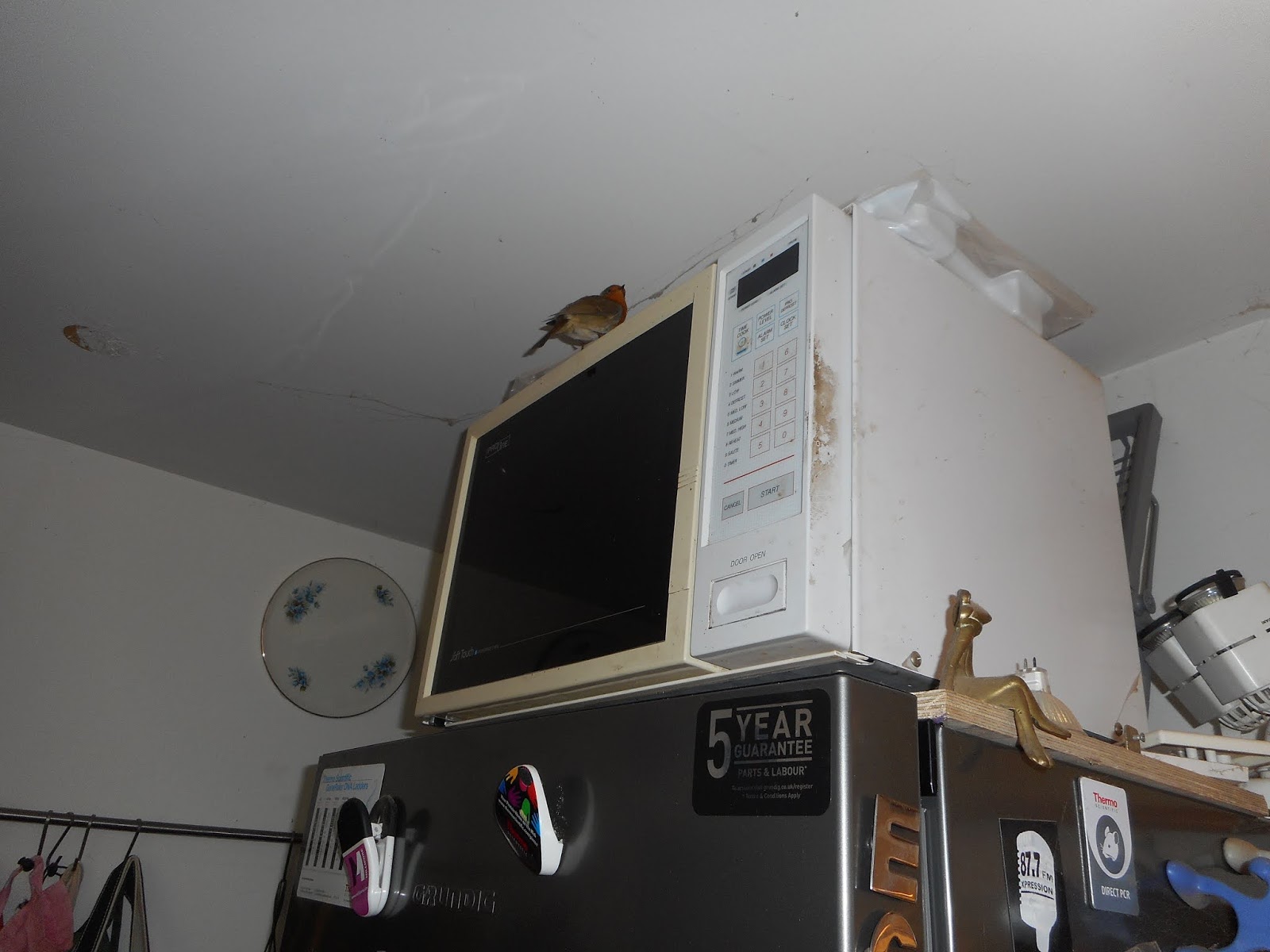
Then birds started invading the house. First, according to Frog, a wren had appeared while I was out walking the dog. It wasn’t there when I got home so it must have escaped through a window. Instead a robin now entered the kitchen and, after flying around banging itself against walls, perched on top of the microwave, which lives on top of the fridge as there’s nowhere else for it. It’s lucky both Frog and I are tall.


Usually, we reckon that birds arrive to tell us when they’ve run out of food, but all the feeders were full and this bird just sat there looking stunned. We wondered if it was a young one that didn’t quite know what it was doing.

Frog, who’s good with errant birds (and errant bees), stood on a stool and enticed it on to his finger.


We then took it out to the caterpillar-infested pots, thinking that we could ‘kill two birds with one stone’ – reduce the population of caterpillars and feed this poor lost creature. Frog even put some of the beasties on to his hand and put his hand under the bird’s beak.


The robin ignored them. It didn’t move. It just sat there looking miserable.


So we left it alone and when I went back half an hour later it was gone. The caterpillars were still there unfortunately and had started falling off the pots and drowning in the water left in the tray by torrential rain.

In my last act of nature conservation, I took the pots out of the tray, tipped the water out and returned the pots to the tray. That way, I thought, both the caterpillars and the plants might stand a chance.

Saturday, 15 August 2020

Blue

Recently, three plants with flowers the same shade of pale blue-mauve have come to my attention, and I thought I’d share them with you.

I know I bang on about wildflowers, but someone has to. They almost never feature on television wildlife programmes but they’re just as important as fauna. None of us would be here without them, and each variety has its niche.

Chicory

Frog, Dog and I saw this uncommon plant yesterday while taking one of our regular routes along the East Devon coast. I also see it from time to time in the organic vineyard behind our house. According to the books it occurs on chalky soil (which that at home definitely isn’t) – but what do the books know?


Chicory, along the East Devon coast, yesterday

Chicory, a few years ago in the field behind the house (used for both growing vines and storing cars . . . ). It's a tall plant


Chicory belongs to the Dandelion family and has the same square-ended petals as Cat's ear (mentioned in a previous post)

Chicory's ground root used to be added to coffee to make it go further, and I remember my mother using ‘Camp coffee’, a sweetened liquid mixture of coffee and chicory, in her scrumptious coffee cake. Apparently chicory is now used on its own as a drink because it’s caffeine free (but what’s the point of that?).


Phacelia

While out and about on the edge of the Somerset Levels last month with Frog and Dog, I saw this plant on the edge of a field. It gave me a shock as I’d never seen it before, or anything like it, and it didn’t appear to belong to any plant family that I knew about. It was like seeing a Martian.


Back home I emailed Plantlife, the wildflower charity to which I belong, and they emailed back the following:

The plant is Phacelia Phacelia tanacetifolia, an annual which is native to the western US. It is widely planted on farmland as both a cover crop or green manure, or as a nectar plant for insects. Once planted, it does sometimes persist for a few years, and it can just pop up from spilled seed or bird feed, or as a contaminant amongst other sown seed.

I was impressed with the answer (its detail and its speed) and encouraged to learn that I was right to see the plant as an alien. I had heard of Phacelia, and had even kept a packet in the cupboard for years waiting to use it as a green manure (but had never done so).

Flax

I do see this plant myself, but this year it was a local friend who brought it to my attention, emailing me a few weeks ago to ask what it was. (Very flattering!)

Photograph by Trish Currie

It’s a cultivated plant which sometimes ‘escapes’, used for linen and oil. Flax (flaxseed) oil is the stuff we eat, and linseed oil goes into paints, the floor-covering lino (linoleum) and cattle feed. I seem to remember that we also used linseed oil on our wooden rounders bats at school. It smelt like cucumber.

And here's a picture of a nearby flax field a few days ago.


Photograph by Trish Currie

There is a wild variety of Flax, with smaller flowers, called Pale Flax. It’s a rare plant, of chalky soils again, and I don’t think I’ve ever seen it.