Tuesday, 17 July 2018

SEVEN DAYS IN NORWAY: DAY 1 Landing at Kristiansand and driving to the Strand Hotel Fevik

Last night at midnight Frog and I returned from a week in Norway, the land of my mother’s mother. We were there for the 75th birthday party of my mother’s sister, who lives in the country. When I was a child we went to Norway as a family every summer to stay in a village by the sea with lots of cousins. As a teenager I visited several times on my own both in the summer and to ski, staying with relatives and family friends. Since then – nearly 50 years ago - I’ve not been back.

Phew. I didn’t know what to expect and felt quite nervous, both about the travel arrangements which hadn’t been easy – travel agents didn’t seem to know about Norway apart from cruises on the fjords*, the northern lights and dog-sledging, but eventually we were sorted out by the wonderful Student Travel Association – and at the prospect of colliding with family (which I don’t find easy at the best of times). I felt better however when I decided to treat the trip as something I was doing for work, as research perhaps for some writing. It wasn’t a holiday; I was there to observe. Detachment was the key. Well, that was the idea anyway.

Having changed planes (and waited four hours) at Amsterdam airport, we touched down at Kristiansand on Norway’s southernmost tip on a blinding afternoon – Norway was having the same heatwave as us.


Having lunch at the Amsterdam Bread Company cafe at Amsterdam's Schipol Airport
Amsterdam's Schipol airport was a scrum but we liked this cafe (The Amsterdam Bread Company) and these stone benches. They were surprisingly comfortable.
Even though Kristiansand is supposedly one of Norway major cities, you could scarcely see the houses for trees, and we had descended over a vast blue bay that reminded me of Sydney harbour in Australia. As we stepped on to the tarmac people waved at us from behind a fence and we were hit with the scent of pine as if we’d been in Greece. Frog beamed. ‘I like it,’ he said. I almost cried. He’d been even more nervous and even more reluctant to go than me.

We picked up a hire car from a charming young man with impeccable English and after ten minutes trying to find out how to start the darn thing and several wrong turnings we reached the E18, one of Norway’s biggest roads, and headed up the coast towards Fevik and the Strand Hotel where the party was to be held. We had the road almost to ourselves, and while Frog concentrated on right-lane/left-hand driving, I distracted him with my squeaks. If we weren’t going through a tunnel under pillars of rock, we were scooting over spectacular bridges above expanses of sparkling water – rivers? lakes? fjords? It was magnificent, amazing, gorgeous.

The hotel staff greeted us with the same easy charm and impeccable English as the car-hire man and, too tired even to wash, we dumped our cases in our room and headed for the bar. We sat on the terrace, looking out over the beach where – even though it was 8 in the evening – people were still swimming, still walking around in towels and bathers.

Having supper on a fine summer evening on the terrace of the Strand Hotel, Fevik, Norway
A hot summer's evening on the terrace of the Strand Hotel looking out to sea
We decided not to worry about the prices (at least double those in the UK) and ordered ourselves drinks and food, and while we waited a lovely Romanian waitress (on her only her second day there and who didn’t speak Norwegian so was delighted to discover we were English) plied us with extra portions of scrumptious (and free) focaccia.

At 11pm we drew our curtains against the light and collapsed into bed. We’d managed the first hurdle: getting there.

* Fjord cruises are not popular with the Norwegians. They add nothing to the local economies and the boats block views and destroy the locals' peace. Just saying.


Wednesday, 2 May 2018

Giant spells and magic pills: writing blogs and novels, taking beta-blockers for migraines


Writing blog posts is like casting a small spell. I detail a development in my life and then publish it. The publishing makes the development real. It is recorded for posterity (whatever that is). I can’t back out or slide back. I have placed my foot on another rung of the ladder.

Writing novels is like casting a giant spell. You write what you want to happen, or even what is happening while you are writing (the real and the imaginary lives are hard to tell apart), but neither takes effect until the novel is published. The publishing is a vital part of the spell.

Unfortunately.

Because I’ve worked in publishing, I’m loath to entrust my baby to it. Is it ready for the commercial world? Is the commercial world ready for it?

But it’s got to be done.

And, yes, I’ve finished the latest draft of The Novel, and now I have to try and get it out there, somehow.

With the completion of The Novel I decided that I really had to do something about my migraines as, for the last few years, I’m been feeling ill most of the time. It’s become a vicious circle. I’m stressed because life is piling up while I’m too ill to do anything about it. I’m depressed because I have to back out of so much ‘in case it gives me a migraine’. I’m exhausted by the illness. And the stress, depression and exhaustion lead to the migraines. They are both the cause and the result.

I’ve had migraines for forty years and for forty years I’ve pursued the complementary way. I wanted to deal with the migraines myself. It didn’t seem right to take some magic pill. They started for a reason and I needed to find out what that was and mend it. Taking a magic pill, say the complementary therapists, only stores up trouble for the future.

Well, I’m 64. When does my future start? How much future do I have? I want to be well NOW. I need something to break me out of the vicious circle and show me a better way to live.

‘I want to be completely free of migraines,’ I said to Frog this morning. ‘I don’t ever want to have to be thinking “I can’t do that because I might get a migraine”.’
    ‘It’s like a parent,’ he said, ‘holding you back all the time.’

Which is a very interesting thought – since that’s what the novel’s about.

As I said, it’s hard to separate the real and the imaginary worlds.

So, 10 days ago I went to the doctor and she prescribed me beta-blockers. And I’ve sent the novel to a couple of publishers.

. . .

Wednesday, 28 March 2018

Images


Because I haven't got time to write, because I'm trying to work on The Novel instead of blogging, here are some images from the last few days.


Last week: a snowdrift with razor-sharp edges almost blocks the path. (Spot the dog.)

On the coast at the weekend. A tree decorated with ribbons and . . .
. . . in the hedge below, a photograph. Are they connected? What do they mean?
'My' island on Monday. A nearby tree has been uprooted and deposited on top of it. The river is still just too deep for me to wade across.


Sunday, 18 March 2018

The world is beautiful now


I might already have three items for the list mentioned yesterday.

1 Expect the unexpected
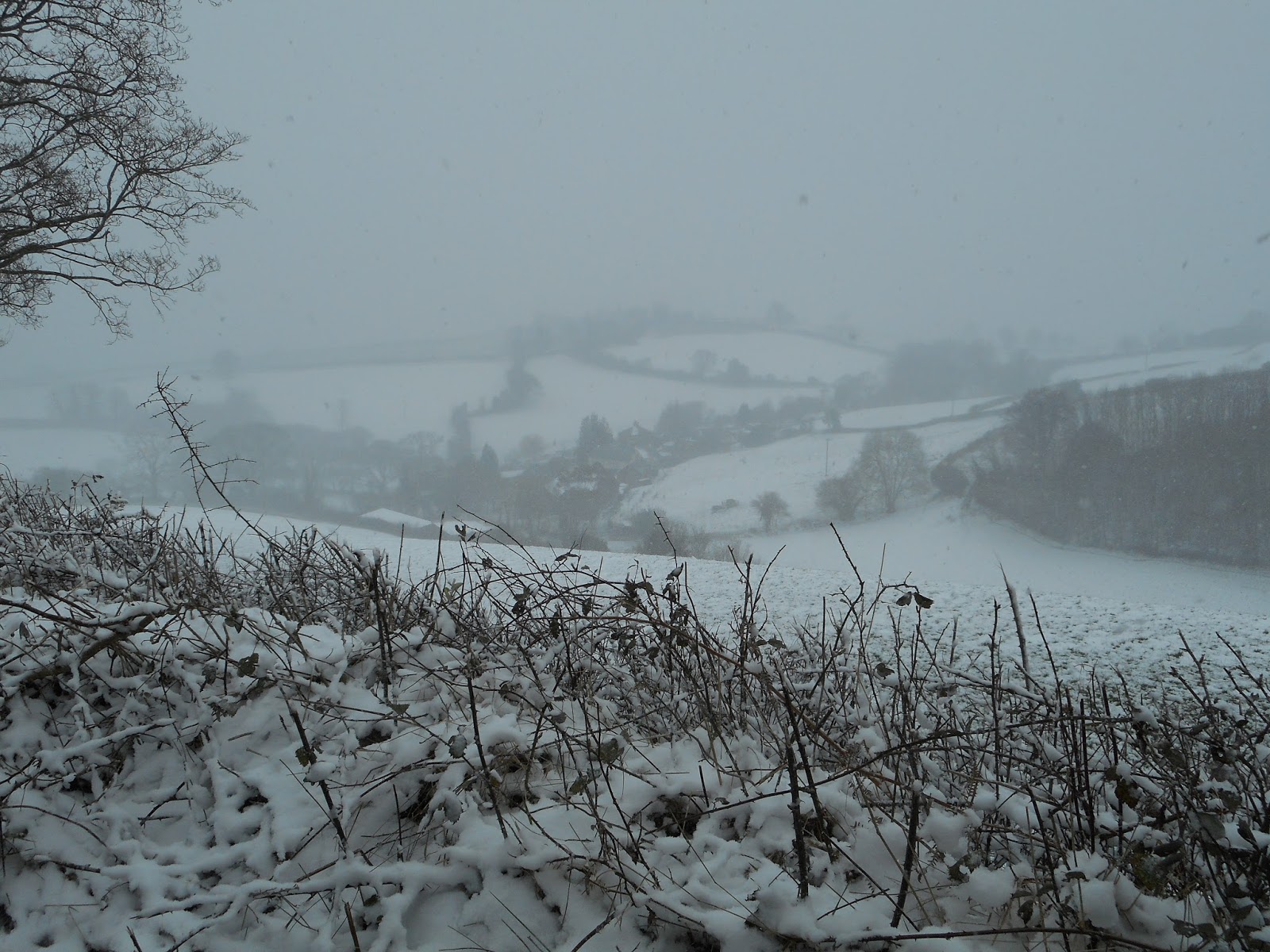
We don’t know how things are going to turn out. They might even turn out well, in spite of all our fears. For instance, I never expected to wake up this morning and find the world transformed into a fairy tale. (I ignore weather forecasts and media warnings on principle, especially after the frenzy a few weeks ago.)

2 We are not in charge
In common with AutumnCottage Diarist, I appreciate the loss of control that extreme weather brings. Extreme weather reminds us that we are part of something bigger. We are not unimportant, but nor are we in charge. That is hugely reassuring.

3 The world is beautiful now . . .
. . . whatever happens in the future. And here are some pictures taken this morning to prove it (I hope).

Whiteout
Trying to photograph snowflakes falling . . .
What is sky and what is earth?
For once Ellie is camouflaged (albeit muddy)
Snow building up along the bottom of my workroom window as I write
And now I really must stop blogging and get back to The Novel.

Saturday, 17 March 2018

Grief, death and positivity


In spite of everything I’ve been saying, I think I am struggling with grief at the moment. And part of grief I suppose is the way it brings death to your attention. In my case, that’s not just the death of my mother, but the future deaths of Ellie the dog, Frog and me.
Who will go first and how will I cope? How will I cope if Frog goes first and I’m left here on earth on my own? How will I cope if I go first and have to travel through the realms of death (whatever they are) without Frog to hold my hand?

And it’s not only those three deaths. What about the current rapid decline and possible future death of the natural world, which is a constant grief for me, exacerbated both by bereavement and by three books I’ve been reading.

In the novel Brendon Chase, probably set around the time of the First World War when the author was a boy, three boys run away from home and live wild in the forest for nine months.
The Peregrine details sightings of this bird and other wildlife around an Essex estuary in the 1950s and ’60s.
Common Ground, published in 2015 (and which I haven’t yet finished reading), describes the author’s intense relationship with a patch of forgotten countryside on the edge of the town where he lives.

Although I didn’t plan it that way, reading these three books – in date order – shows up the decline in the natural world with excruciating clarity.
In the novel, the boys hunt, shoot and trap wild animals without a qualm: they joke for example that they can’t eat duck any more because they’ve killed all the birds which used to live on the pool nearby. Could you even live in a forest any more for that long without seeing anyone else (except in their case a charcoal-burner)? Do forests that size still exist and would they be people-free?
At the time of the writing of The Peregrine the bird was threatened with extinction and the author writes of the landscape, ‘It is a dying world, like Mars, but glowing still.’ That still holds true, even though peregrine numbers are recovering with the banning of certain chemicals, and he describes a host of other wildlife which I never see or hear any more (partridges, cuckoos, thrushes).
Common Ground brings us up to date. The countryside described is anything but pristine. It contains litter, discarded barbed-wire (which kills a fox), a derelict railway, electricity pylons, traffic noise and a rough sleeper. Even so, the author loves it (because of the way it is, not in spite of). He discovers that it is earmarked for development – 900 houses. But what can he do?

What can any of us do? How can we stay close to nature when nature is vanishing? How can we live in a way that is not destructive to nature? How can we help stop the decline? And am I even asking the right questions?

I think I feel another list coming on. A list of answers, I hope, as well as a list of ways to stay positive, of antidotes to grief and death.

But that could take some time and now I must walk the dog.