I am pleased to report, therefore, that it has now been meticulously restored by Celandine Books of Wiveliscombe and I’m thrilled with the result. The book has kept all its character and turned into something beautiful and usable again.
| Before |
| After |
I am pleased to report, therefore, that it has now been meticulously restored by Celandine Books of Wiveliscombe and I’m thrilled with the result. The book has kept all its character and turned into something beautiful and usable again.
| Before |
| After |
Yesterday morning, while walking along the canal near where I live, I saw this beautiful wild plant for the first time.
| Flowering Rush |
My Book says it’s Flowering Rush, rather uncommon, flowering
from July – and there we were, Ellie and I, on our nearby canal in June, and it
was dotted all along the bank.
Well, My Book is over 60 years old and it gets a lot of things wrong because so much of both countryside and climate has changed, but I love it because it was given to me by my parents on my eleventh birthday and it’s full of my annotations and observations over the years.
Needless to say, it’s falling apart now, and if you know of a good bookbinder who could repair it for me, do tell.
| My ancient and battered Oxford Book of Wildflowers |
Next I saw this tall scruffy plant which I find rather menacing as it grows in gangs and looks like a Triffid (as in the 1981 TV adaptation of John Wyndham’s book). It’s called Hemp Agrimony, but is no relation to Cannabis (sadly) or Agrimony - which is a small yellow spike of a flower, and one I also saw yesterday along the canal.
| Hemp Agrimony |
| Hemp Agrimony |
| Agrimony |
The next plant to catch my attention was this Meadow-sweet,
so-called I presume for its scent – a weird almondy one. I like its confidence
and its scatty prettiness and am trying to grow it round the pond in my garden.
| Meadow-sweet |
Sunny St John’s Wort was in flower for the first time this
year. As you probably know, the word ‘wort’ means any plant that was used medicinally
and St John’s Wort is still used to cure depression (but take advice as it can
also be harmful or interact with conventional drugs).
| St John's Wort |
Lovely Scabious, which actually prefers dry places, was in
evidence from time to time, well attended by insects like all flowers of the
Daisy family to which it belongs.
| Scabious and Hoverfly |
Yesterday was a good day.
The Grand Western Canal near Tiverton in Devon is a Local Nature Reserve and well worth a visit at any time of year. Yesterday it was full of birdsong as well as wildflowers, and when I find out how to transfer audio and video clips from my phone to my computer I’ll share some of that with you as well.
I made it to Norway eventually and swept into a round of parties, meeting cousins of all shapes and sizes (my maternal grandmother having been Norwegian). The weather was atrocious – even worse than in the UK – but here are some pictures of the beautiful landscape.
On the first day I walked with my brother and sister-in-law and two English friends of my aunt to this lake, which Frog and I had found near the hotel five years earlier. In spite of non-stop rain, I thought the lake was prettier this time. Perhaps the heatwave on my previous visit had withered the greenery.
The jetty is for swimming. The Norwegians are very hearty and, even though the temperature was about 14, as we walked back two boys were leaping in and out of the water.
The rock in the foreground is not broken concrete but granite, which comes to the surface everywhere.
Here is the hotel garden on my last day, when of course the sun came out, and here is another lump of granite. How the trees manage to grow on it, I have no idea.
As children, we spent our summer holidays by the sea in Norway and clambered over the rocks in bare feet, as this was the best way we found to grip them.
Also on my last day, I found this enticing path signed ‘Kyststien’ which I guessed meant coast path. I wished I’d found
it earlier.
Most of the interior of the country (below the treeline) is forested with pines but here, by the coast, were some broadleaved trees – oak, silver birch, rowan. Also scrumptious wild raspberries, another feature of my childhood.
This is the beach in front of
the hotel, but I didn’t brave the sea.
On my penultimate day, I went for lunch with one of my aunt’s daughters. She lives on the outskirts of Kristiansand.
Here is her view.
And here is the path from her garden to forest and mountain.
On my last morning, I walked round Kristiansand with my brother and sister-in-law.
Here is the harbour, not what you’d expect next to a city.
People were picnicking and swimming.
As you can see, nowhere in Norway is far from nature, although according to a cousin that is changing as the population expands.
That breaks my heart, as (in my experience) Norway is one of the
last wild places left in this part of the world.
I’ve mentioned before my guru Louise Hay and her book You Can Heal Your Life.
I’ve also mentioned my disinclination at the moment to get
out of bed in the morning and face the world, and the bad back and leg that
have crippled me since November.
Last night when I couldn’t sleep yet again because of the pain in my right calf, which paracetamol hadn’t touched, I decided to explore with the help of my beloved Notebook what was going on.
According to Louise, pain in the lower leg is caused by fear of the future and not wanting to move on. The affirmation (to counteract that) is:
I move forward with confidence and joy, knowing that all will be well in my future.
I said this to myself over and over and found myself sobbing so I knew she was right.
I’ve been through this process again and again recently and I keep forgetting, and falling into old ways, and believing what everyone else says instead of what I say deep inside me. For instance, out of fear I’ve been to see a physiotherapist, which is what my doctor recommended for my back and leg, even though I don't normally do conventional medicine, and all it’s done is make me feel worse.
One day, I might manage to hold on to me.
And, of course, as I might also have said before, that is what this time since Frog’s death is all about. I have the idea that moving on will take me away from him, but actually it will take me towards him.
Even though Frog and I had the deepest of connections, I couldn’t be myself when he was here because I was too preoccupied with being a good wife, with being what I thought he wanted. He removed himself in order to help me and now, in order to rejoin him, I have to face the world without him and learn to be me. It’s bloody terrifying.
Wish me luck.
And in case none of that makes sense, which is more than likely, here are some pictures from the last week or two. Isn’t the world beautiful? Why on earth should I fear it?
![]() |
| Floods |
![]() |
| Shining Cranesbill, a tiny flower named for its shiny leaves (the small roundish ones) |
![]() |
The nearby Weeping Willow, waving its
hair-like tresses |
![]() |
| My Secret Wood, a fluff of greeny-brown about to burst into life |
![]() |
| The buds of Holly flowers, another secret |
![]() |
| Dandelions like suns and Dandelions with Speedwell, the colour of the sky. (Spot the dog.) |
From 1977 to 2019 Frog (my late husband) was connected with Exeter University’s student radio station. He looked after the equipment and gave continuity and advice to the ever-changing student members. He also presented his own programme, The Frog Prog, on which he played his unique choice of music, both popular and classical, from all eras, and passed on his encyclopaedic knowledge of all things musical.
Last June, past members of the radio station put together a tribute programme for Frog
https://www.mixcloud.com/XpressionShowcase/john-frog-whitworth-memorial-show/
and I’ve been crying my way through it. Sometimes they really catch his character and talents and it’s given me a whole new appreciation of him.
I’ve been doing a lot of crying lately. Since November in fact when I acquired a bad back. The pain then went to my legs where it has stuck ever since. It’s terrified me because, now I’m on my own, I have to manage. I can’t be ill or incapacitated. I have a dog to mind.
![]() |
| Ellie at one year old. She's now twelve and a half. |
But what I realised this morning is that the pain has made me get in touch with my feelings. It’s lowered my defences and let the grief come to the surface. It’s given me time. I haven’t been able to rush around clearing Frog’s stuff, forging a ‘new life’ and being brave. I’ve spent a lot of time alone, in my dressing-gown, writing in my Notebooks (a sort of diary), using up tissues.
And at the risk of sounding crass, I thought I might link all that to the slow emergence of spring, another turning point, as evidenced by the following pictures.
![]() |
| Rooks' nests by the canal |
![]() |
| The weeping willow over the lane below the house, always the first tree to burst into leaf |
![]() |
| Ivy berries, like bunches of grapes, important food for birds at this time of year |
![]() |
Beech flowers |
Not for nothing is
Kent known as the Garden of England. You can hardly see the village here for its thick cover of trees |
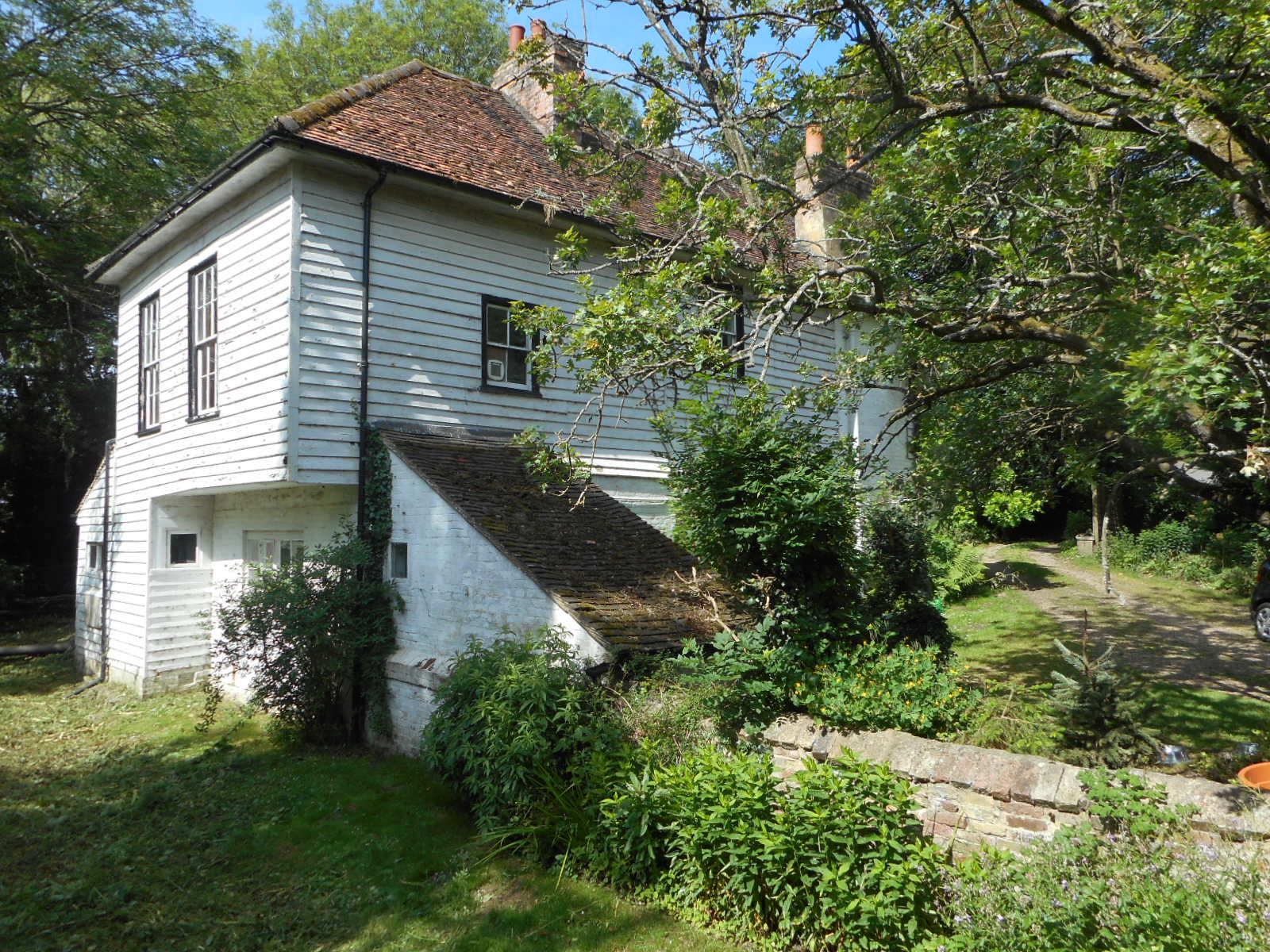
K’s house is a mill house dating from the sixteenth century,
with uneven wooden floors and a warren of rooms, easy to get lost in. It lives
on an island enclosed by three arms of a river. Greenery abounds – both exotic and
native, nature rules, and the whole place is full of magic.
| The Mill House |
| The river and the Mill House garden |
| A walk in a nearby valley |
Parts of the valley are being rewilded.
| Shrubs and trees are racing to re-cover what was once agricultural land and then a golf course |
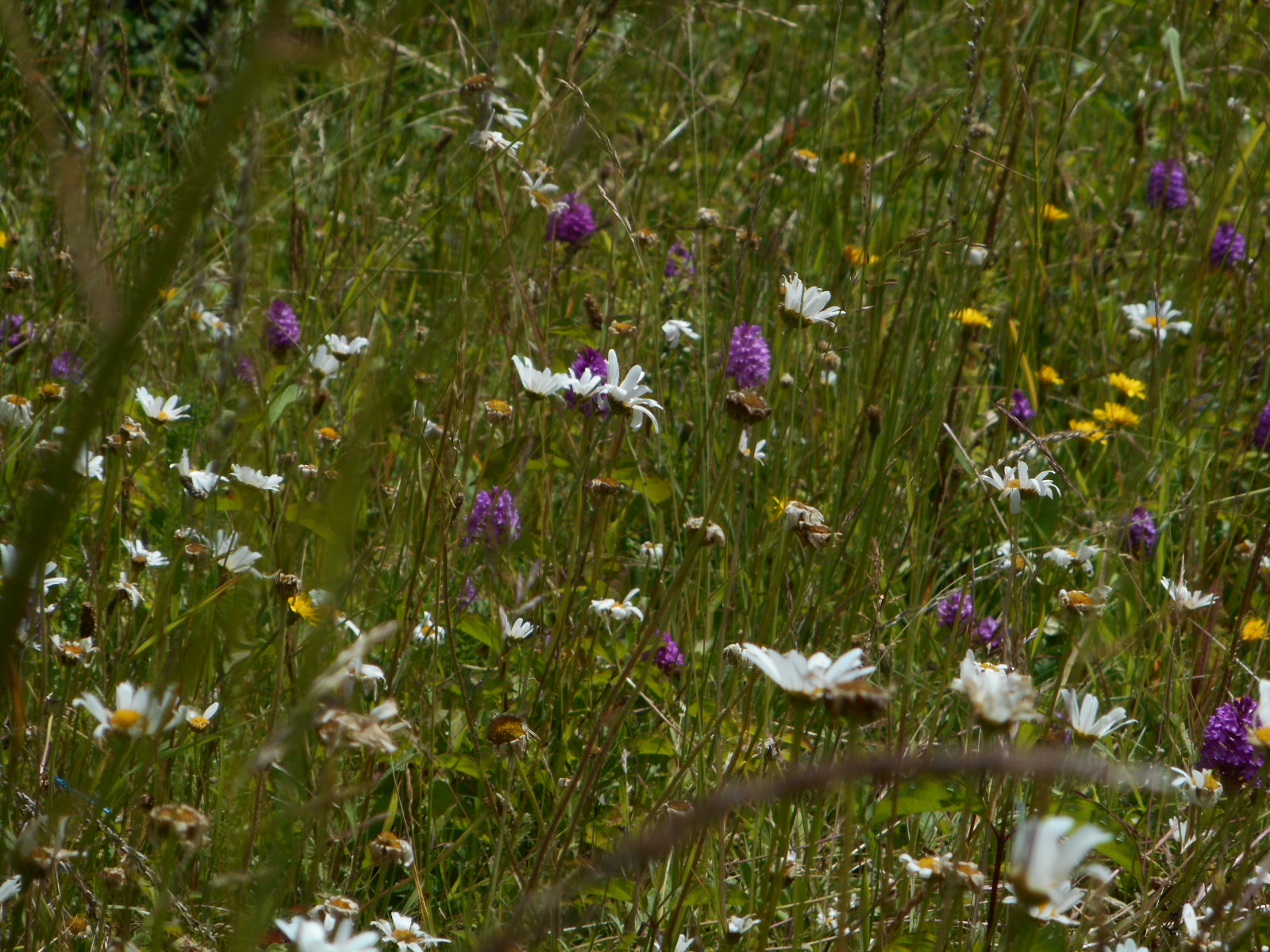
| Pyramid orchid and Bacon and eggs (Birdsfoot-trefoil), one of nature's stunning colour combinations |
| Another sort of orchid. (My sister A would know its name.) |
On Friday, the hottest day of the year so far, we took
refuge in the Mill House’s shady garden.
| Drinks and lunch in the Mill House garden |
Another day we walked along the river, past these hop fields, for which Kent is famous,
| Hop field |
and these lavender fields, which take advantage of Kent’s
hot, dry summers as well as the rise in overall temperatures.
| Lavender field, planted to flower in succession |
The scent as we walked past was delicious.
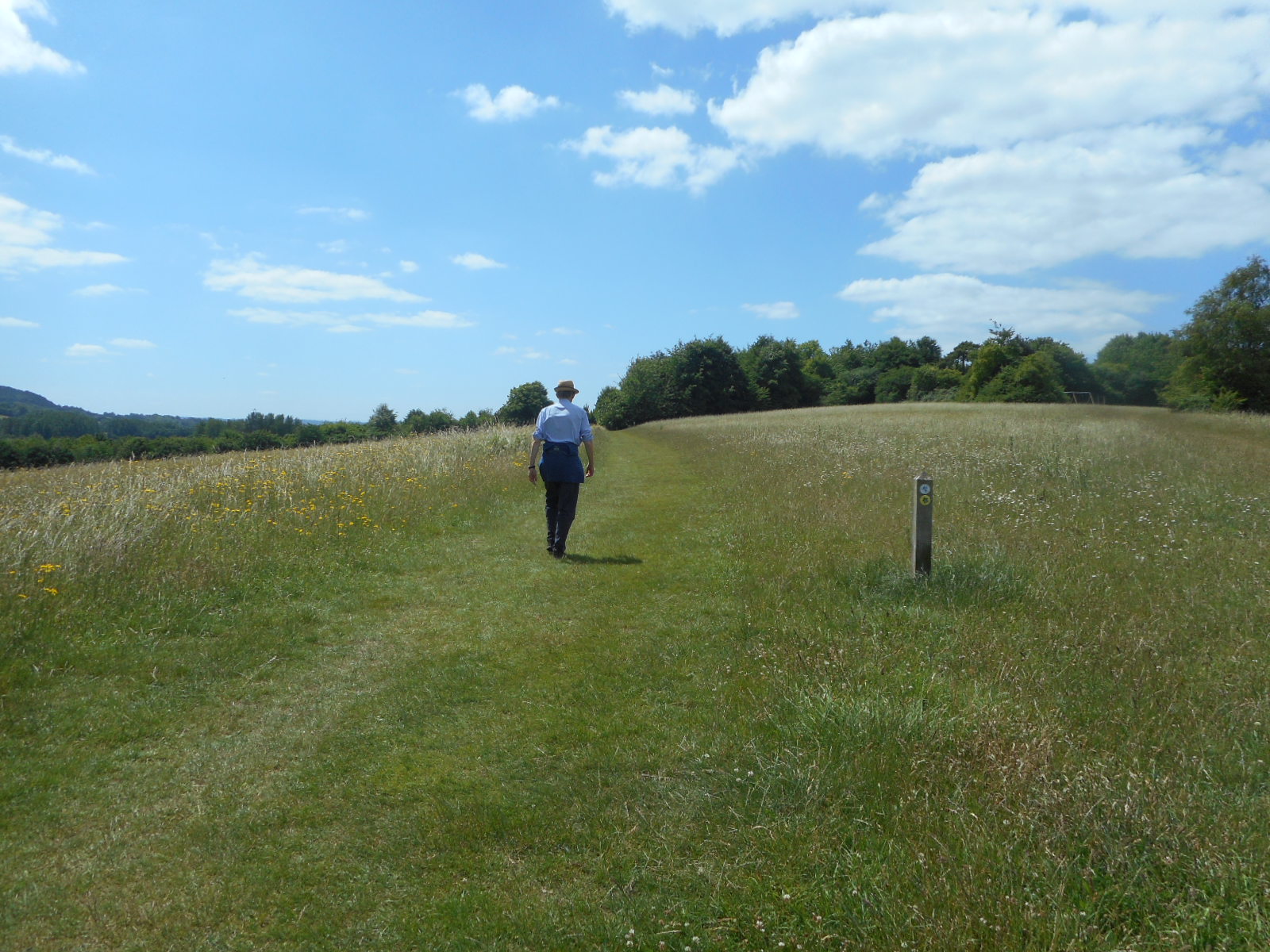
Nearby the council has created a country park with a glorious wildflower meadow . . .
| The wildflower meadow with neat paths and signboards (and my brother) |
| The wildflower meadow with rows of lavender just visible behind trees in the distance |
| The meadow's wildflowers, including more orchids |
Imaginative seats (from handmadeplaces.co.uk*) are placed appropriately: a
dragonfly by the river, a grasshopper here by the meadow.
| The wooden seat in the shape of a grasshopper (which has, inconveniently for the photo, placed itself half in and half out of shade) |
It was a good place to sit and rest.
| Brother J on the grasshopper |
Heartfelt thanks to my family for giving me such a wonderful
time.