Sunday, 17 April 2022

Happy days

Two evenings ago, the night before the full moon, I suddenly noticed my wild cherry tree. It was in full bloom and the scent of the flowers was filling the garden.


My wild cherry tree


The nearly full moon, half an hour or so later

I have this theory that every flower has its momentary peak and, if you’re lucky enough to catch it at that peak, the experience is extraordinary. This was one of those moments.
 
But where were the bees? Surely bees need to catch flowers at their peak as this, I presume, is the flowers’ most fertile time. Or, to put it another way, the flowers are doing their utmost to attract the bees when they need them. Perhaps the tree is pollinated by night-flying moths. Who knows?
 
The more I look into nature, the more questions I have, and the more I realise that we don’t know everything about how the natural world works. In fact, we hardly know anything. How exciting that is!
 
I’ve been visiting my secret wood nearly every day, so as to catch the bluebells at their peak, if I can, if I’m lucky enough, if God wills it. You can’t grasp at nature. You have to let it come to you.

My secret wood, in a valley created by two small streams, untouched because too steep to cultivate


The wood's first bluebells in a patch of sunshine


En route I’ve seen many other wildflowers bursting into bloom.

Garlic Mustard, aka Jack-by-the-Hedge,
a favourite food of the caterpillars of the Orange-tip butterfly 


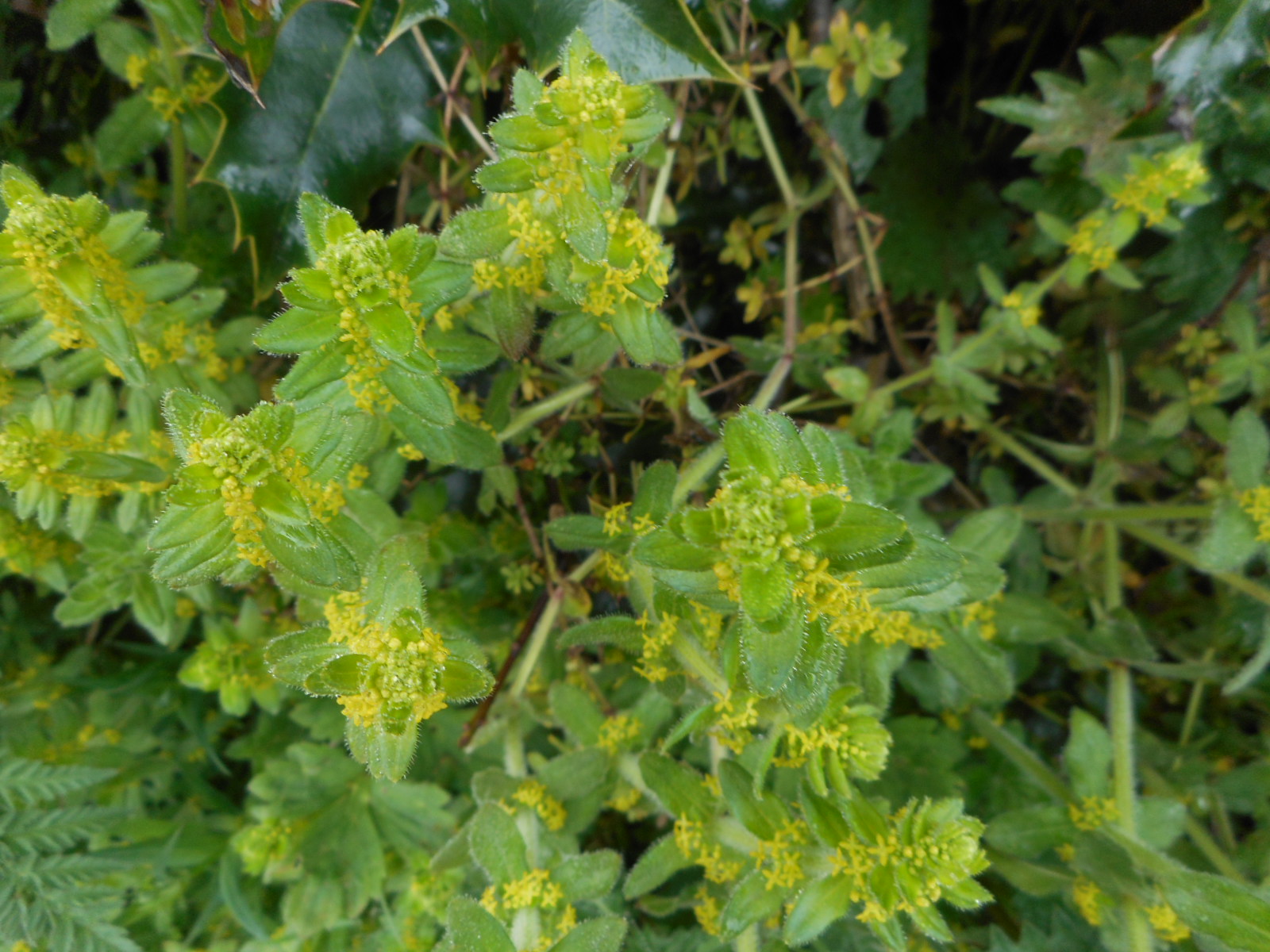
Crosswort, so called because the leaves and the petals come in fours arranged in a cross.
It's related to what most people call Sticky Weed and what we as children called Goosegrass.
(Sorry for the blurred photo. I was in a lane and car came past and I had to grab Ellie.)


Cowslips, which shouldn't grow round here because they like chalky (not sandy) soil. This is a solitary patch which comes up every year and I'm always so pleased to see it.

I’ve noticed fungi as well, another of nature’s mysteries.

White tree fungus, like a clump of foam


Black tree fungus, like lumps of coal


The remains of a puffball, on the ground

Happy days. In nature, I feel closest to Frog. I know now that he’s still around me all the time and that he's guiding me. He told me so on one of my walks.

Friday, 8 April 2022

Thirteen weeks and two days

It’s now thirteen weeks and two days since Frog died. If anything, I feel worse than I did three months ago. I’m worn down by sleepless nights and my rapidly falling weight. I can’t believe that my body keeps going.

I try to hold on to my beliefs. I do my breathing exercises and make positive affirmations. I pray and go for long walks and sit in my secret wood with Ellie for hours, bathed in the healing power of nature. Neighbours, friends and family rally round. But the grief doesn’t go away. It frightens me.

Meanwhile, spring advances in fits and starts.

Ellie keeping me company in my secret wood. The carpet of bluebell leaves hints at the glory to come


Greater Stitchwort masses along the footpath


Pussy Willow is bursting into bloom. Already the flowers smell unbelievably sweet and soon the tree will be buzzing with bees.


Golden Saxifrage clusters on the banks of streams


The first Cuckoo Flower (Lady’s Smock) yesterday in the damp meadow behind the house. An insect has found it too.


Why do I have to be so desperately unhappy? Why can’t I simply be grateful for the near half-century that Frog and I spent together? Why can’t I simply remember that time with joy? Why can’t I simply rejoice in my new-found closeness to my brothers and sisters and the kindness that greets me at every turn? Why can’t I hold on to my belief that Frog and I will meet again?

Why does the grief outweigh everything?


PS You can now sign up (again) to receive an email when I publish a new post. See under the picture at the top of the column on the right. Let me know (if you can) if it doesn't work.


Tuesday, 15 March 2022

Three days in the life

Since Frog died (10 weeks ago) my two sisters and two brothers have been taking it in turn to come and stay, keeping me company and helping with the myriad practical tasks that have now come my way. Each brings their own brand of support. Last week it was the turn of J, who is the admin expert and also, since retired, turning out to be a pretty handy sort of person all round.

On Friday, in driving rain, we filled a skip with all the debris that had been collecting around the back door for decades.


I had no idea what most of it was (other than mysterious electronic boxes, wires, lumps of metal, lumps of plastic) and I had tried to sort it into piles for recycling at the tip but I then decided, bu- - er it (as Frog would say). I have a bad back at the moment, I didn’t have the strength to load and unload the car and anyway I couldn’t work out how to put the car’s back seat down.

It was very satisfying.

We then moved to the carport all the boxes and bags that had been cluttering up the conservatory.

The boxes were the result of a preliminary clearing of Frog’s debris in kitchen and sitting-room, mostly stuff that, again, he hadn’t used for decades (pens, badges, frog ornaments, puppets and, again, numerous unidentifiable wires and connectors).

The bags contained clothes and shoes. At the suggestion of my sister E, I had kept my favourites of both, and Frog’s favourites, and all the clothes that I had made for him. It wasn’t a question of getting rid of everything; it was a question of keeping a selection to remember him by.

Frog was a hoarder and for 44 years I had lived in his shadow, keeping small areas clear for myself and ignoring the rest of the house. Now, in order to move on, I had to make space for myself. It was heart-rending but vital. Frog didn’t need the stuff any more, he’d left it behind, and in order to join him – as, when and wherever ‒ I had to leave it behind as well.

These boxes and bags we covered in a tarpaulin and left for a charity to collect.


The next day, we tackled some of the dreaded admin (transferring savings and investments into my name, informing utility and insurance companies, contacting the Land Registry about ownership of the house etc etc). This again is heart-rending task, not made any easier by the unpleasantness of some of the institutions who seem to go out of their way not to help one, and by the fact that I couldn’t contact anyone by phone because it made cry. J is a godsend.

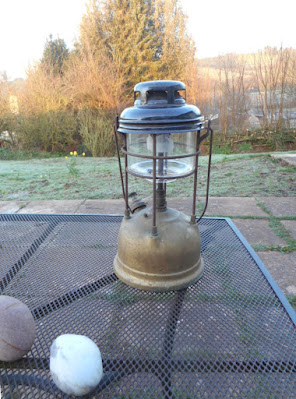
Then we turned to the Tilley lamp which I’d found in the shed and tried to use during Storm Eunice when I was without power for 8 hours.


We had some experience of Tilley lamps from sailing holidays when we were children and I'd watched a video on YouTube and printed out some instructions. 

However, after – with great difficulty – installing a new ‘mantle’ (a sort of net that soaks up the paraffin and burns), spilling paraffin all over the kitchen, and two abortive attempts to light the darn thing, we decided that the pumping lever (which creates pressure in the paraffin well and sends the paraffin up the tube to the mantle) was caput, and gave up. Watch this space for the next instalment.

The next day, we went to the sea. We left home in wind and rain and arrived on the coast in beautiful sunshine. It was spring at last and wildflowers were starting to burgeon.

The first Alexanders, only found by the sea

The first violets

Ivy berries, one of the few things birds have to eat at this time of year

In spite of the weather, we had the beach almost to ourselves

Ellie has found something interesting under the pebbles.
(I had to alter the picture because the sea was flowing downhill and unfortunately in the process I lost my brother's top half

Celandines, glowing in the sun

That night, perhaps because that part of the coast was somewhere Frog and I had loved visiting together, and perhaps because I knew J was leaving the next day, I had one of my meltdowns.

The counsellor I’m seeing says that they’re a symptom of shock, the result of sudden traumatic loss. They make me feel as if I have nothing inside me but panic and that I’m trapped in a small black box by myself for ever and ever.

I went outside to look at the stars and J stood by.

Saturday, 19 February 2022

Frog

Frog died suddenly of a heart attack at the age of 69 on 5 January this year. Today would have been his seventieth birthday.

When I first met him 44 years ago I knew that we’d been together in previous lives. All I can hope for now is that we will meet again and be together in a life or lives to come.

We had his cremation last week and Mark Gilborson, the Civil Celebrant, found this poem for me and read it out at the service. It is one of my lifebelts.


Death is nothing at all

 
Death is nothing at all.
I have only slipped away to the next room.
I am I and you are you.
Whatever we were to each other,
That, we are still.
 
Call me by my old familiar name.
Speak to me in the easy way
which you have always used.
Put no difference in your tone.
Wear no forced air of solemnity or sorrow.
 
Laugh as we always laughed
at the little jokes we enjoyed together.
Let my name be ever the household word
that it always was.
Let it be spoken without effect.
Without a trace of a shadow in it.
 
Life means all that it ever meant.
It is the same as it ever was;
There is unbroken continuity.
Why should I be out of mind
Because I am out of sight?
 
I am waiting for you, for an interval,
Somewhere very near, just around the corner.
 
All is well.
 
                    Henry Scott-Holland (1847-1918)


Frog at one of his favourites jobs:
clearing the drains in the road below the house so that it didn't flood


Frog in his den (a semi-underground music room)

Friday, 18 February 2022

Rewilding update

The tree people arrived in the middle of January: lovely Irish Ken Hogan (www.kenhogantreeservices.co.uk ) bringing with him a cake for me from his lovely wife ‘Mole’ together with an assortment of young lads.

They chainsawed the dreaded Leylandii which were blocking all the light at the bottom of our garden. They were able to leave stumps some four foot high as conifers don’t resprout like broadleaved trees do. These stumps will become covered in ivy, which provides food and cover for birds and insects in the winter.

A Leylandii stump (and my neighbour's house)

With a powered winch, they hauled out the remains of the field maples which had been taking up more and more space and obscuring our lovely views. They left these rooted stumps upside-down in piles as habitat for creatures of all shapes and sizes. These piles I discovered are called, unsurprisingly, ‘stumperies’.


Stumperies

They sliced the tops off the willows and elder that had grown unbelievably tall and spindly in order to compensate for the Leylandii. Although all looks bare now, these should bush out and give us much better screening than before while restoring our sight of the horizon and sunsets.

A once-leggy tree, ready to bush out

I called this ‘coppicing’ but Ken called it ‘pollarding’. Google says that ‘coppicing’ involves cutting trees back down to ground level, while pollarding means leaving them a few feet high, so Ken is right.

With a mammoth machine they shredded most of the piles of cuttings that Frog and I had made in the autumn when we started trimming everything, as well as all but the largest of what they had produced. This they chopped into logs for my neighbour who has a wood-burning stove (and has been supremely tolerant of all the work and told me to do what I liked).

They left some piles of wood around . . . 

A pile of wood (to the right) and my shadow

. . . as these host insects and fungi and rot down to nourish the soil, as well as making good hiding places for small mammals.

They also placed some of the cuttings in a line as a sort of hedge.

The row of cuttings. (The fence is there to stop Ellie racing into the road or into my neighbour's garden.)

This provides a structure for things to grow through and can be added to as cuttings become available. Again, it provides habitat for fauna and, I discovered, is called a ‘wind-row’, so I suppose it gives protection against wind (of which we get a lot).

They left the shreddings in a massive pile next to the house. Neighbours have been helping themselves to carloads of the stuff for use on muddy paths and I’ve been putting them in the deep holes left when the field-maple roots were pulled out as well as on my veg beds as feed and mulch. As you can see, however, there’s still quite a lot left.

A root-hole filled with shreddings

Shreddings mulching one of my veg beds

A beached whale of shreddings. As you can tell, this pile was once double in size and stretched out on to the grass. Thanks to my sister Anna who spent a long time scraping the chippings off the grass when she came to stay.


We’ve now discovered a whole new section of garden and have the makings of what I see as a ‘dappled dell’.


The dappled dell

Already snowdrops and other bulbs that I never knew existed are pushing their way through.

Snowdrops which have appeared by magic in a part of the garden once dark and dead.

In due course, I might plant one or two small trees with blossom and food for birds, such as crab-apple or hawthorn, but I’m not in any hurry. I shall see what happens naturally first.

Meanwhile, I’ve had to completely rearrange the sitting-room so that we can sit on the sofa and take in the glorious views. And when the weather’s better I might even manage to take a picture of what we can see.

Once, we cowered in the middle of a wood. Now, we live on a mountain-top.


Thanks once again to my lovely nieces and nephews who’ve shown such interest in my rewilding project, not least Mark who's just started a business https://www.aklimate.co.uk/   helping organisations to be carbon neutral.