Friday, 15 July 2011

A proper gardener


I had a migraine yesterday so was lying outside under a sun umbrella. When I turned over I saw this corner of the house.
    ‘That looks like something created by a proper gardener,’ I thought.
    At the back are tomato and cucumber plants donated by gardening friends. (Thank you, Alan. Thank you, Pat.)
    The ‘trellis’ is what Frog calls racking. He rescued it from the university (where he works) when they were refurbishing a lab and chucking it out.
    In the front are my new parsley plants and an olive tree bought by Frog.
    Also my brand new watering can which I actually bought myself - with a voucher that came in a free local paper. It sprinkles, unlike my old one which has had its spout nibbled by Dog. (The old one was given to me by my sister Emma many years ago. I still use it – just not for sprinkling.)
    This south-westerly wall is baking hot after a day of sunshine, with the bricks acting like a giant storage heater and keeping the plants warm all night. It works better than the southerly wall round the corner (where I have some chilli plants, also donated).

Wednesday, 13 July 2011

Thomas

I wrote this eight years ago about something that happened fifteen years ago. For the full story, see ‘Mother’s Day’ (April).


You weren’t very pretty
when you came out –
all wrinkled and red.
They dressed you in a bonnet and shawl
and  put you in a crib
then showed you to us both
even though you were dead.
Frog cried buckets
so I stayed brave.
Frog’s brave now
but I can’t cry any more.
I’m the one who’s dead,
while you sail on
and spring comes to Devon.

Tuesday, 12 July 2011

Wildflowers in the garden

Deep down Frog and I are the same, but on the surface we differ in just about everything.
    In the house for instance I am a minimalist whereas Frog’s possessions accrue in awful dusty heaps and spread like cancer.
    ‘I just take a long time to put things away,’ says Frog when I bark my shins yet again and swear.
    ‘Yes,’ I mutter darkly. ‘Like twenty years.’
    In the garden however, our roles are reversed. Frog has a collection of machines of destruction – chainsaw, mower, hedgetrimmers, strimmer – which he longs to use ‘to keep the garden tidy’. I on the other hand, so long as we have somewhere to sit out, I can grow some vegetables, and we can see our views, would rather leave it to nature.
    Mostly we manage to compromise, and here are some of the wildflowers that have escaped Frog’s flails, some self-seeded and some planted by me.
    I don’t want to get on my soapbox here, but why grow foreign plants which need cosseting and could be invasive (such as the dreaded Japanese knotweed, giant hogweed, Himalayan balsam and a pond weed whose name I’ve forgotten) when we have so many lovely native plants? Or am I being racist?


Hedge woundwort, which has seeded itself in the paving slabs next to some Greek oregano (which has itself spread from a flowerbed). What a lovely colour combination. I like this plant, even though it doesn’t smell pleasant, as it feels friendly. Another of the ‘worts’, used for staunching wounds, as you might expect. Its leaves yield a yellow dye, so one of my books says.


Bindweed, crawling all over the shrubs. I’m conducting an experiment: will it take over, or will it reach sensible proportions and then stop?


Tiny self-heal, in the lawn, used in the past for sore throats, headaches, chest ailments, internal bleeding, piles and fevers, to close wounds and as a general strengthener. Wow. Did it work? I’ve no idea.


Feverfew, which I think I planted once and which has now spread itself into the strangest places. Here it is in a dark corner of the carport. A herbalist once prescribed a tincture of feverfew for me to take when I had migraines but it didn’t work. I read somewhere that I should be eating a leaf a day as a preventative. I tried one once and it was disgusting.


Meadow cranesbill, which I don’t think I’ve ever seen in the wild. Presumably it’s one of those plants that used to grow with crops in fields but because of herbicides does no more. I sowed some in the garden and it lives very happily in the flowerbeds, spreading but not taking over.


Toadflax, also planted by me. It’s supposed to be a pest in gardens, but I’ve never found it so. I love the name. ‘Flax’ I can understand because of the shape of the leaves, but ‘toad’? I must check out my mother’s copy of Richard Mabey’s Flora Britannica. Maybe that would tell me.


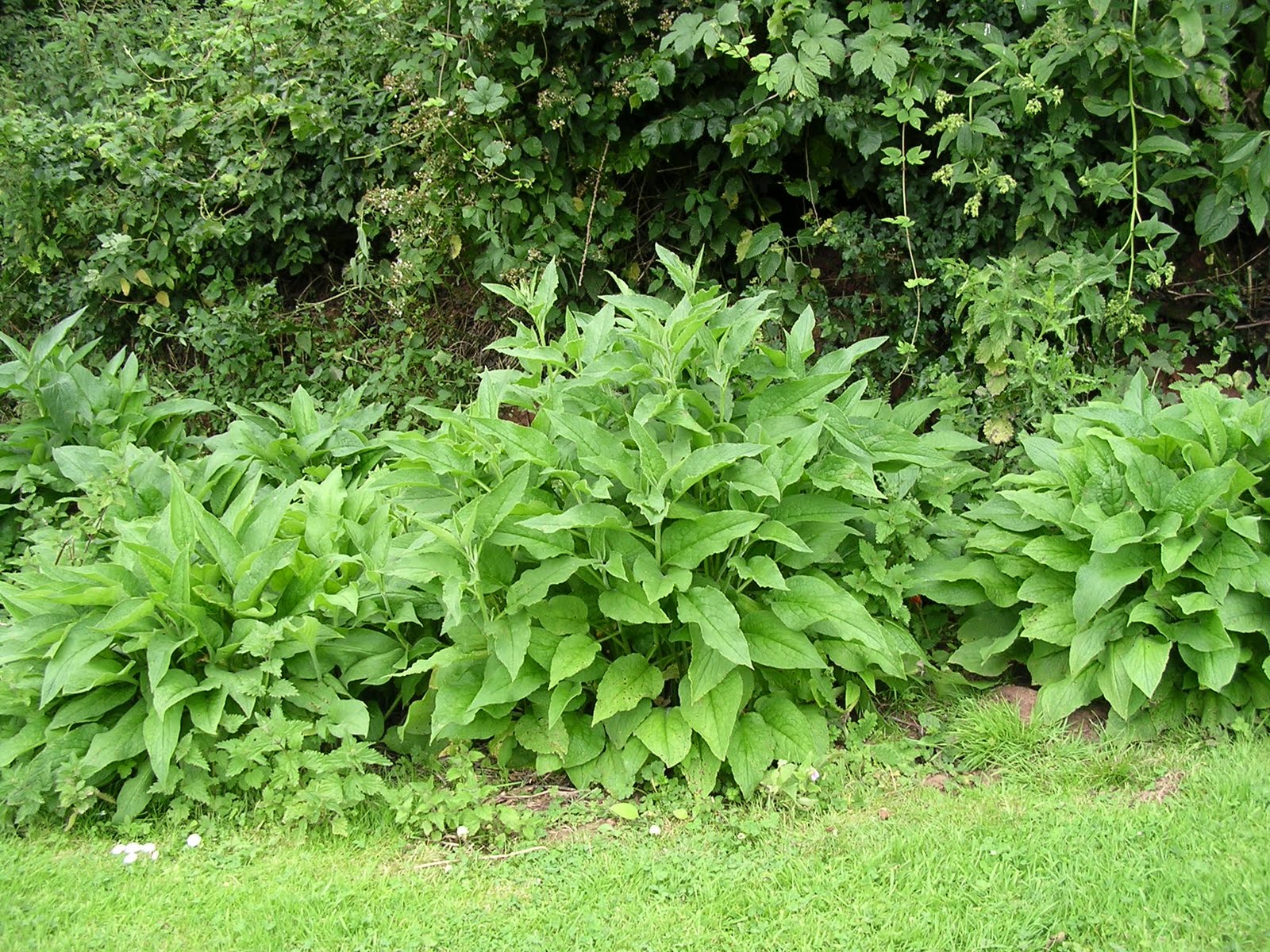
Comfrey, of course, beloved by organic gardeners, planted by me and now all over the place. Frog razed these clumps to the ground two weeks ago (me hurriedly gathering up the stuff and filling one and a half compost bins) and look at them now. As well as composting comfrey, I use it as a mulch on my veg bed. Does this work, do you know? Are the nutrients released this way?

Monday, 11 July 2011

Paying attention

One of the blogs I follow is called ‘a small stone’ (http://www.asmallstone.com/ ). In it the writer records one tiny observation for each day ‘like a stone picked up on a long walk and carried home in your pocket’. What a lovely idea.
    She says that she uses the blog to help her pay attention and she hopes it will do the same for us, the readers of her blog.
    Indeed it does.
    I made two observations this morning.

Ellie and I were walking through a wood when a herd of Guernsey cows and calves thundered past at speed on a narrow track, led by one quad bike and followed by another. We were both fascinated.

As we drove home, a lorry came in the opposite direction. On the passenger seat, next to the male driver, was a life-size cut-out of a blonde bimbo dressed in shocking pink.

    Roselle, in her blog ‘Qualia and other wildlife’ (www.roselle-angwin.blogspot.com ), points out that ‘things are things-in-themselves and can also be signposts to other more subtle realities’. In other words, we see what we need to see. Like dreams, the things we notice are actually glimpses into what is happening in our subconscious, glimpses of what is in the process of emerging from the compost heap of the subconscious and becoming conscious. They are omens.
    Recording observations, like recording dreams, like any writing in fact, makes the subtle concrete. It clears blockages in the subconscious/conscious interface and moves along the psychic processes. That’s why we do it, I suppose.
   Goodness knows though, on the evidence of the above, where my processes are heading.

Sunday, 10 July 2011

Wildflowers

I’ve at last discovered how to take close-up pictures with my camera, or rather I’ve discovered that there is a special setting for close-ups, so can share another of my passions with you. My camera was thrown out by my brother because it had stopped working but retrieved and made to work again by Frog. Unfortunately, we didn’t have an instruction book and, because I’d never had a digital camera before, I had no idea what the camera could do. Frog has now printed out some instructions for me from the internet.
    I hated biology at my secondary school. The teacher was cruel to us, there were cages of locusts in the lab – climbing all over the glass making scratchy noises - and we had to do horrible things like cutting up dead frogs. One project however, keeping a wildflower diary, enthused me. What’s more, the mother of a friend in the village who was in my class at school, was a wildflower expert.
    Miranda’s mother took us all over the North Downs, where we lived, helping us identify plants and taking us to the secret places where the rare plants like orchids grew. The North Downs are particularly rich in wildflowers because the thin chalky soil is not much good for farming so the hills are left – as beechwood and as closely cropped sheep pasture. Sometimes I headed out alone, coming back with armfuls of wildflowers to press or draw. (I would NEVER pick a wildflower today.*)
    Then, in the summer, I went with my family on holiday to the Norfolk Broads and was able to take a canoe on my own up hidden creeks and discover a whole new world of wildflowers. I felt like an Amazon explorer, imagining that I was seeing things that no other human had seen, going to places untouched by human hand and identifying plants for the very first time.
    The next year they awarded two special prizes at the school – for wildflower diaries. Miranda got first prize and I got second. Exactly as it should have been (although I was pretty peeved at the time).
    The M25 goes through the North Downs now and wildflowers are endangered all over, with some already extinct (I think).** I find this frightening.
    In Devon however we are lucky enough still to have some room for wildflowers, and here are some of them, photographed over the last few days around where I live and by the sea twenty or so miles away. (As you will see, I still have a lot to learn about the best way to capture them on camera.)


Lady's bedstraw. This sweet-smelling plant was used to stuff mattresses.


St John's wort, still used to treat depression.
Any plant with 'wort' in its name - and there are many - was once used medicinally.


We used to call this 'eggs and bacon' in Kent because of the brown markings (bacon) on the yellow petals (eggs). In Kent, with the dry climate and nibbling sheep, it grows about a tenth of the size it does here in lush Devon. Its official name is 'birdsfoot trefoil'. 'Birdsfoot' because its pods splay out like birds' feet and 'trefoil' because it has three-lobed leaves like clover, to which it is related.


This spooky plant was growing in deep shade. I think it's a broomrape, rare parasitic plants, possibly 'red broomrape' which, according to my beloved Oxford Book of Wildflowers (given to me by my parents on my eleventh birthday), grows by the sea in the south, (parasitic) on wild thyme - which is an example of how specific are the needs of some plants.


This tall, triffid-like plant has the splendid name 'hemp agrimony'. My book says it likes damp woods, marshes and riversides but I've only ever seen it by the sea, in Devon and Brittany. Another of my books says that recent research has shown that it might be useful in the treatment of cancer and AIDS.


The lovely star-like lesser stitchwort.
Apparently it used to be chewed to relieve muscular pain and 'stitches'.
Alternatively you could stew it in wine and powdered acorns (yummy).
In Devon they used to say that if you pick stitchwort you risk being led astray by pixies.

Must stop now and go and plant out my leeks and parsnips. And no I don't weed unless I really have to (and then usually only bindweed and couch grass, and I do apologise to the plant and explain what I'm doing before I start).

*Since writing this, I’ve done some research. It is actually illegal to uproot any wild plant without the landowner’s permission, or to pick, uproot or destroy any of the plants on the endangered list.
** One in five native plants (about 345 out of 1,756 in 2008) is either ‘critically endangered’, ‘endangered’ or ‘vulnerable to extinction’ according to internationally recognised criteria.